Showing posts with label books. Show all posts

Thursday, September 02, 2010

Tough questions

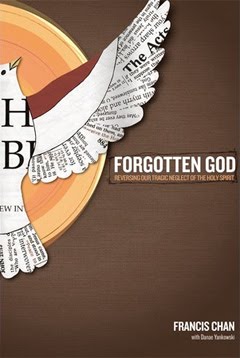
I'm currently reading "Forgotten God: Reversing Our Tragic Neglect of the Holy Spirit," by Francis Chan. I'll readily admit that I was first attracted to the book because of its beautiful cover, but once I discovered what the book was about I was equally excited for its content.

I appreciate Chan's honest writing and Biblical approach to this book. Chan, the pastor of a Cornerstone Church in Simi Valley, California, writes like he's giving a sermon. He presents his points clearly (and with a lot of Biblical references), often urging the reader to put down the book and instead read a relevant section of the Bible. 

Overall, the book is a fairly simple and straightforward study of the Holy Spirit. Chan doesn't present anything earth-shattering or new, but instead explores foundational themes central to our belief in the Holy Spirit -- like a list of truths about the Holy Spirit, or a list of ways the Holy Spirit manifests itself in our daily lives.

I'm about halfway through the book, and came to a passage that I found particularly challenging to me personally. The quote I mainly wanted to include here is in bold, but I felt I needed to include the rest for context: 

Did God lead you to where you are? A lot of people in my church and in my travels tell me, "I believe that God has called me to Simi Valley." Or Wichita. Or New York. Or Greenville. Or wherever. That very well may be the case. But it could also be a cop-out because you like where you live. You have a good job. The school district is safe and has high ratings. Your family lives close by (or perhaps far away, depending on your relationship with them). It makes sense that you are "called" to be there, right?
And maybe you are calle to where you live. But if you say you are called to be in the place you are, a few questions need to be considered. For example, how would you be missed if you left this place? What would change? Basically, what difference does your presence here make? Or, as my youth pastor once asked me, what would your church (and the worldwide church) look like if everyone was as committed as you are? If everyone gave and served and prayed exactly like you, would the church be healthy and empowered? Or would it be weak and listless?

Yikes. That's an awfully convicting question. If I answered it honestly I'd have to say that the church wouldn't be very healthy at all. Definitely some food for thought.

Thursday, December 24, 2009

The Law of Undulation

On the drive to Cincinnati yesterday, I listened to a radio dramatization of "The Screwtape Letters," C.S. Lewis' famous  look into the mentoring relationship between two devils – a junior tempter (Wormwood), and his uncle, a senior tempter (Screwtape). In the story, Wormwood is tempting his first human, and his uncle gives him tips and hints about how to adequately keep humans away from the "great enemy:" God.

I made it through about half of the set yesterday, and was pleasantly surprised at the quality of the dramatization. I was totally engrossed. The voice acting helped, too – Andy Serkis (Gollum) was fantastic as Screwtape, and the other actors, though lesser known, performed their parts equally well.
I was struck yesterday by the dramatization of the eighth letter from Screwtape to Wormwood, dealing with the "law of undulation." I'd quote the whole chapter if I could, but that wouldn't be exactly legal – so, just a snippet. (Someone has posted the whole chapter, and most of the book, here).
Humans are amphibians—half spirit and half animal. (The Enemy's determination to produce such a revolting hybrid was one of the things that determined Our Father to withdraw his support from Him.) As spirits they belong to the eternal world, but as animals they inhabit time. This means that while their spirit can be directed to an eternal object, their bodies, passions, and imaginations are in continual change, for to be in time means to change. Their nearest approach to constancy, therefore, is undulation—the repeated return to a level from which they repeatedly fall back, a series of troughs and peaks. If you had watched your patient carefully you would have seen this undulation in every department of his life—his interest in his work, his affection for his friends, his physical appetites, all go up and down. As long as he lives on earth periods of emotional and bodily richness and liveliness will alternate with periods of numbness and poverty. The dryness and dullness through which your patient is now going are not, as you fondly suppose, your workmanship; they are merely a natural phenomenon which will do us no good unless you make a good use of it.
To decide what the best use of it is, you must ask what use the Enemy wants to make of it, and then do the opposite. Now it may surprise you to learn that in His efforts to get permanent possession of a soul, He relies on the troughs even more than on the peaks; some of His special favourites have gone through longer and deeper troughs than anyone else. The reason is this. To us a human is primarily good; our aim is the absorption of its will into ours, the increase of our own area of selfhood at its expense. But the obedience which the Enemy demands of men is quite a different thing. One must face the fact that all the talk about His love for men, and His service being perfect freedom, is not (as one would gladly believe) mere propaganda, but an appalling truth.
Lewis goes on to discuss the role of free will in the "war" for human souls, but that's a slightly different topic (and, of course, a very debatable one). The "Law of Undulation" is, in itself, a broad topic that we can apply to our lives and walks of faith in a variety of different ways. With this blog post, I mostly just wanted to point out how much I believe in the point that Lewis is making – that our lives naturally have highs and lows, because of the way we have been created and because of the sinful and broken nature of our world. Often, when we're in a valley, we look only for the path that will take us to the next peak – but we should recognize that God is in the valleys as much as or more than he is in the peaks. When we find ourselves in a downward trough of undulation, we should ask ourselves what God wants to make of it.

This pattern of undulation won't end until we're at home in heaven. There's a verse in Isaiah that speaks to this:
Every valley shall be lifted up,
and every mountain and hill be made low;
the uneven ground shall become level,
and the rough places a plain.
And the glory of the Lord shall be revealed,
and all flesh shall see it together,
for the mouth of the Lord has spoken.”
- Isaiah 40:4-5

Friday, December 18, 2009

Time away

DSC_0188
Christmas break has finally arrived! I finished my last final on Tuesday, so now I have – quite literally – nothing to do for three and a half weeks. Doubtless I'll fill most of my days with reading, episodes of LOST, Age of Empires III and random acts of tomfoolery. I'll be heading home to Cincinnati for a few days on either side of Christmas. Over the New Year's holiday, Sarah and I are heading to New England to visit Lake Champion, Sarah's brother's family in New York City and my sister's family in Portland, Maine, where we'll hopefully go skiing (Sunday River) and hit up the L.L. Bean Outlet in Freeport.
I'm also going to make a point to photoblog during break – especially during the New England trip. Without schoolwork to do, I'll need something to focus on!

Anyway, as I mentioned before, I decided to start off my Christmas break by taking a personal retreat. After spending some time looking for a location, I settled on St. Meinrad, a Benedictine Monastery and seminary in southern Indiana. The seminary had some interesting history – it was founded in 1852 by Swiss monks who were looking to expand their abbey to the United States as an insurance policy against the anti-Catholic Swiss government of the time. If the Swiss government became too oppressive, the monks planned to pack up and move to America. However, that never happened, and by the 1870s St. Meinrad had become an independent monastery.

I arrived Wednesday afternoon and pretty much spent all of my time in reading and prayer. I took an hour in the afternoon to walk around the grounds and take photos, and also attended the evening Vespers service in the monastery. The most interesting reading I was doing was from Tim Keller's "Counterfeit Gods," an excellent book about modern idolatry. When I'm finished with it I may have to devote a post to it.

Anyway, here's a few pictures. These were all taken with my Tokina 11-16mm f/2.8. I'm digging the superwide.

DSC_0074
DSC_0080
DSC_0094

Wednesday, June 10, 2009

Of Lorien, Nature and the Four Loves

I'm continuing my Lord of the Rings reread, and I have to say that this time through (this is probably the sixth or seventh time I've read them) I'm focusing on taking deeper lessons from the story instead of just reading for entertainment. Of course, participating in a LOTR book club on Monday nights with some brilliant friends only helps the cause.

One of the themes we've talked about a bit at the book club is nature. Both Tolkien and C.S. Lewis use nature as a thematic element in their fantasy stories, and both seem to have similar methods of introducing and using it.

And as it so happens, I've been thinking a lot about the role of nature in my life lately. I just returned from a wonderful vacation where I got to see both the piney splendor of the Pacific Northwest and the rocky lakeshores of the Catskill Mountains. While traveling, I began to read C.S. Lewis's The Four Loves, which includes a great section about nature. So, let me start this off with a section of The Fellowship of the Ring. The Fellowship has just emerged from the Mines of Moria and, under the leadership of Aragorn, decides to seek refuge in Lothlórien. Boromir shows some reluctance to enter the forest.

He stepped forward; but Boromir stood irresolute and did not follow. 'Is there no other way?' he said.

'What other fairer way would you desire?' said Aragorn.

'A plain road, though it led through a hedge of swords,' said Boromir. 'By strange paths has this company been led, and so far to evil fortune. Against my will we passed under the shades of Moria, to our loss. And now we must enter the Golden Wood, you say. But of that perilous land we have heard in Gondor, and it is said that few come out who once go in; and of that few none have escaped unscathed.'

'Say not unscathed, but if you say unchanged, then maybe you will speak the truth,' said Aragorn. 'But lore wanes in Gondor, Boromir, if in the city of those who once were wise they now speak evil of Lothlórien. Believe what you will, there is no other way for us – unless you would go back to Moria-gate, or scale the pathless mountains, or swim the Great River all alone.'

'Then lead on!' said Boromir. 'But it is perilous.'

'Perilous indeed,' said Aragorn, 'fair and perilous; but only evil need fear it, or those who bring some evil with them. Follow me!'

Boromir isn't afraid to speak his mind, and speak it plainly – even if he is wrong (one of the reasons I like him, but that's another story). Boromir, subject to what must have been the Gondorian equivalent of an urban legend, believes the woods to be wicked and evil. Aragorn corrects him, noting that the woods is dangerous, but that the real danger lies within one's own heart (think Star Wars: Luke's strange cave training with Yoda).

C.S. Lewis echoes this sentiment in The Four Loves.

"If you take nature as a teacher she will teach you exactly the lessons you had already decided to learn; this is only another way of saying that nature does not teach."

Lewis suggests that Nature is a myriad of different things all at once: it's life and death. It's beautiful and terrible. It's forgiving and unforgiving. As Lewis puts it, it at once includes, "overwhelming gaiety, insupportable grandeur and sombre desolation."

But Lewis certainly doesn't suggest that Nature is without its merits. He continues:

"Nature never taught me that there exists a God of glory and of infinite majesty. I had to learn that in other ways. But nature gave the word glory a meaning for me. I still do not know where else I could have found one."

For Lewis, the lesson that Nature taught was one of God's glory. Lewis believes he never would have fully understood God's glory – or learned to fear God – without "certain ominous ravines" and "unapproachable crags." But to others, Nature appeals to the "dark gods in the blood." Though Nature can suggest glory, it presents other things, too – sex, hunger and power operate in Nature without shame.

We can certainly see this idea of nature as a "mirror" in Tolkien's Lothlórien, among other places. Boromir is right to fear the woods, because the woods will expose the fears that he carries in his heart. Tolkien's Nature, in and of itself, is not good or evil. It may reflect the good or evil present in it (as I'll note presently) or, in its natural course cause actions that seem to be good or evil, though they are neither (the foiling of the Fellowship on Caradhras).

We can see the effect of good or evil in nature if we read on to the end of the Lothlórien chapter. The Fellowship has reached Cerin Amroth, a hill with a vantage point of the surrounding lands. Frodo pauses to look out over the golden wood:

Frodo looked and saw, still at some distance, a hill of many mighty trees, or a city of green towers: which it was he could not tell. Out of it, it seemed to him that the power and light came that held all the land in sway. He longed suddenly to fly like a bird to rest in the green city. Then he looked eastward and saw all the land of Lorien running down to the pale gleam of Anduin, the Great River. He lifted his eyes across the river and all the light went out, and he was back again in the world he knew. Beyond the river the land appeared flat and empty, formless and vague, until far away it rose again like a wall, dark and drear. The sun that lay on Lothlorien had no power to enlighten the shadow of that distant height.

'There lies the fastness of Southern Mirkwood,' said Haldir. 'It is clad in a forest of dark fir, where the trees strive one against another and their branches rot and wither. In the midst upon a stony height stands Dol Guldur, where long the hidden Enemy had his dewlling. We fear now that it is inhabited again, and with power sevenfold. A black cloud lies often over it of late. In this high place you ay see the two powers that are opposed to one another; and ever they strive now in thought, but whereas the light perceives the very heart of the darkness, its own secret has not been discovered. Not yet' He turned and climbed swiftly down, and they followed him.

Nature can appear to be good or evil depending on both what is inhabiting it, and, again, depending on the perspective of the beholder. As Lewis would say, it teaches us no lessons than those we already wish to learn.

Instead, Lewis suggests we should "learn our theology and philosophy elsewhere." That we must "leave the hills and woods and go back to our studies, to church, to our Bibles, to our knees." And, in a specific note to nature lovers, Lewis continues, "Otherwise the love of nature is beginning to turn into nature religion. And then, even if it does not lead us to the Dark Gods, it will lead us to a great deal of nonsense."

I don't know about you, but to me this all makes perfect sense. I believe wholeheartedly – especially since I tend to be a "nature lover" – that the love of nature must be anchored in truth. Additionally, Tolkien's storytelling seems to back up the theological stylings of his good friend Lewis. Lothlórien is just one example.

As a parting thought: At book club on Monday we discussed Radagast, Gandalf's wizarding peer with a deep affection for nature (and possible St. Francis parallel). If Lewis suggests that a pure love of nature will, at best, lead to a "great deal of nonsense," then perhaps that's one reason why Radagast is considered a simpleton and a fool in the books.

Tuesday, January 27, 2009

Sawtelle

I laid awake for a good hour last night after I turned the light off. I'd just finished reading "The Story of Edgar Sawtelle," by Dave Wroblewski, and my mind just wouldn't shut off.

It's a great book, and I highly recommend reading it. There are the obvious undertones of "Hamlet," but Wroblewski's writing also seems to combine the traits of some of my favorite American writers – John Steinbeck, Richard Adams and John Irving.

Wroblewski's writing waxes poetic – he's wonderful at describing things in a way you haven't quite heard before. His best writing is about abstract concepts, though, and I particularly enjoy the few chapters that are about the family's dog, Almondine. Her loyalty and devotion are touching. I don't want to give much away, but here's a passage from a chapter about her from late in the book:

"She had learned, in her life, that time lived inside you. You are time, you breathe time. When she'd been young, she'd had an insatiable hunger for more of it, though she hadn't understood why. Now she held inside her a cacophony of times and lately it drowned out the world. The apple tree was still nice to lie near. The peony, for its scent, was also fine. When she walked through the woods (infrequently now) she picked her way along the path, making way for the boy inside to run along before her. It could be hard to choose the time outside over the time within. There was still work to do, of course. The young ones in the barn knew so little and she had taught so many before. It hardly seemed worth trying when she was asked, though she did."

Sunday, February 24, 2008

Land me safe on Canaan's side

I wanted to post the words to a hymn that has really struck a chord with me over the past few months, and has come to be a great source of insight and encouragement in my life.

The hymn is "Guide me O, Thou Great Jehovah," penned by the Welshman William Williams (what a name) in 1745. Here are the lyrics:
Guide me, O Thou great Jehovah,
Pilgrim through this barren land.
I am weak, but Thou art mighty;
Hold me with Thy powerful hand.
Bread of Heaven, Bread of Heaven,
Feed me till I want no more;
Feed me till I want no more.
Open now the crystal fountain,
Whence the healing stream doth flow;
Let the fire and cloudy pillar
Lead me all my journey through.
Strong Deliverer, strong Deliverer,
Be Thou still my Strength and Shield;
Be Thou still my Strength and Shield.
When I tread the verge of Jordan,
Bid my anxious fears subside;
Death of deaths, and hell’s destruction,
Land me safe on Canaan’s side.
Songs of praises, songs of praises,
I will ever give to Thee;
I will ever give to Thee.
Gosh, I love this hymn. "Lord... guide me through this desert with your powerful hand... through streams and fires, anywhere on my journey, be my strength and shield. I will not fear, though I face death, for you will guide me, and I will ever sing you songs of praises."

The whole point is that we don't know what's ahead, but we walk in faith anyway, trusting that even if God leads us into fire – yes, he'll do that - he'll deliver us through it.

Though we may have the desire to know what's next, that's not something God is typically going to just come out and reveal to us. Instead, perhaps God will talk to us as Aslan does to Lucy in C.S. Lewis' "Prince Caspian." ((I just finished re-reading it not long ago, so it's fresh in my mind )).

"Please, Aslan!" said Lucy, "am I not to know?"

"To know what would have happened, child?" said Aslan. "No, nobody is ever told that."

"Oh dear," said Lucy.

"But anyone can find out what will happen," said Aslan. "If you go back to the others now, and wake them up; and tell them you have seen me again; and that you must all get up at once and follow me—what will happen? There is only one way of finding out…"

"But they won’t believe me!" said Lucy.

"It doesn't matter," said Aslan.

"Oh dear, oh dear," said Lucy. "And I was so pleased at finding you again. And I thought you’d come roaring in and frighten all the enemies away—like last time. And now everything is going to be horrid."

"It is hard for you, little one," said Aslan. "But things never happen the same way twice. It has been hard for us all in Narnia before now."

"Lucy buried her head in his mane to hide from his face. But there must have been magic in his mane. She could feel lion-strength going into her. Quite suddenly she sat up.

"I’m sorry, Aslan," she said. "I’m ready now."

I love the way Aslan talks to Lucy: The only way you will find out what can happen is by doing. And there is great encouragement to be found in the Lord in facing this task, as well, for he promises us ((just studied this in small group, too)):

When you pass through the waters, I will be with you; and through the rivers, they shall not overflow you. When you walk through the fire, you shall not be burned, nor shall the flame scorch you.
- Isaiah 43:2


Anyway, just a few thoughts as I face a time of uncertainty in exactly "what's next" – though I trust God that if I make a step of faith, he will be with me, guiding me through whatever flames and floods may come.

Friday, September 14, 2007

The Electric Company

I've always fancied myself to be a bit of an environmentalist and conservationist. I'm certainly not ready to join Earth First or Greenpeace, but I love the world that God has given us and believe we should protect it.

Recently God has really laid it on my heart to do everything I can as an individual to save the planet in small ways. I've been listening to some really excellent sermons on the subject – namely the "God is Green" series by Rob Bell and his compatriots at Mars Hill Bible Church (if you're going to listen to one, listen to "God is Green IV: Tomatoes and Towers," which you can download here). I've also been doing a little bit of independent research on the Internet, and I have been reading some really interesting books on what it means to be a Christian and love the planet. "Serve God, Save the Planet," by Dr. James Sleeth, is an excellent, page-turning book that has opened my eyes to the excess waste I generate every day. Sleeth, a former New England ER doctor, gives spiritual reasons why we should care about the planet, and then explains how we can take action in practical ways.

Our electricity bill from Duke Energy for August was $75.74. It's one of the higher electric bills we've had to pay, but we finally caved in in August and ran the air conditioning for consistent days. Luckily our apartment stays pretty naturally cool, but the consistent combination of 98 degree days with 90 percent humidity was a bit much.

So here's the current goal: halve the electricity bill. Granted, it will be a little easier since September brings cooler weather and open windows, but it will take a little extra effort to get the bill below $38.00. The lowest we've paid since we moved into the apartment in December is about $60. I'm not sure how the end result will turn out, but here's the plan of action:
  • Turn out the lights! Probably the most obvious answer, but still very applicable. Lights need to be turned out when not in use.
  • Turn off & unplug. This goes for computers, appliances, and other random electric devices. This means turning off the computer entirely, instead of just letting it go to sleep. It means unplugging small electric devices that draw a constant current – for example: the electric shaver I have that doesn't need to stay plugged in when it's already fully charged. Larger devices like the television and stereo draw power even when they're turned off. TVs draw current because they're always "partially on" – waiting for you to click the remote and turn the set on. Most stereos have what's called "phantom power" – power that's provided even when it's turned off. By using a surge protector to shut power to these devices completely off when they're not in use, a lot of electricity can be saved.
  • Energy-efficient light bulbs. OK, they're still expensive, and I can't afford to buy a lot of them right now. And it's wasteful to replace bulbs that are still perfectly good. However, I did buy four compact fluorescent bulbs to replace the most commonly used bulbs in our house. Compact fluorescent bulbs use about 25% of the electricity traditional incandescent bulbs use to produce the same amount of light (lumens). They also don't generate heat and last a lot longer.
  • No dryer. A clothes dryer draws an enormous, enormous amount of electricity. As Sleeth points out, it would take five work horses rigged to a turbine to generate enough electricity to run a clothes dryer. That's a lot of power. I've got a clothesline, and I can use it.
  • Our clothes dryer has a light bulb in it that turns on when you open the door. Granted, this takes a miniscule amount of energy, but it's pretty ridiculous. I don't need a light in the dryer. I'm going to disable it.
  • Canvas grocery bag. Sure it's a little dorky to carry around, but I really don't need to throw away five plastic grocery bags every time I go shopping.
  • Bike and walk. I already bike the three miles to work most days, I'll just have to get that extra motivation for those days I really don't feel like pedaling.
  • Windows open! Obviously this one is going to be pretty easy for the month of September. We'll see how it goes after that.
Again, these are simple, everyday things we can all do to be more conscious about the beautiful world God has given us. The less power we use, the less power plants we need. If fossil fuel power plants go offline, we have the benefit of having less pollution and less dependence on oil.

I'm not advocating that we need to shut down our modern lives and live in a semi-neolithic sate. But there are many, many ways we can be more responsible with the incredible amount of luxury we are afforded by living in a country like the United States.

Will definitely post more on this topic later, including the results of the electric bill test in about a month.