Showing posts with label christianity. Show all posts

Thursday, September 02, 2010

Tough questions

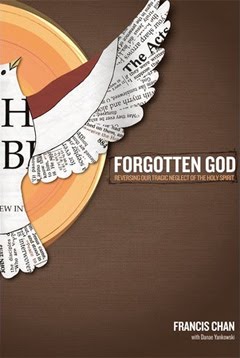
I'm currently reading "Forgotten God: Reversing Our Tragic Neglect of the Holy Spirit," by Francis Chan. I'll readily admit that I was first attracted to the book because of its beautiful cover, but once I discovered what the book was about I was equally excited for its content.

I appreciate Chan's honest writing and Biblical approach to this book. Chan, the pastor of a Cornerstone Church in Simi Valley, California, writes like he's giving a sermon. He presents his points clearly (and with a lot of Biblical references), often urging the reader to put down the book and instead read a relevant section of the Bible. 

Overall, the book is a fairly simple and straightforward study of the Holy Spirit. Chan doesn't present anything earth-shattering or new, but instead explores foundational themes central to our belief in the Holy Spirit -- like a list of truths about the Holy Spirit, or a list of ways the Holy Spirit manifests itself in our daily lives.

I'm about halfway through the book, and came to a passage that I found particularly challenging to me personally. The quote I mainly wanted to include here is in bold, but I felt I needed to include the rest for context: 

Did God lead you to where you are? A lot of people in my church and in my travels tell me, "I believe that God has called me to Simi Valley." Or Wichita. Or New York. Or Greenville. Or wherever. That very well may be the case. But it could also be a cop-out because you like where you live. You have a good job. The school district is safe and has high ratings. Your family lives close by (or perhaps far away, depending on your relationship with them). It makes sense that you are "called" to be there, right?
And maybe you are calle to where you live. But if you say you are called to be in the place you are, a few questions need to be considered. For example, how would you be missed if you left this place? What would change? Basically, what difference does your presence here make? Or, as my youth pastor once asked me, what would your church (and the worldwide church) look like if everyone was as committed as you are? If everyone gave and served and prayed exactly like you, would the church be healthy and empowered? Or would it be weak and listless?

Yikes. That's an awfully convicting question. If I answered it honestly I'd have to say that the church wouldn't be very healthy at all. Definitely some food for thought.

Thursday, December 24, 2009

The Law of Undulation

On the drive to Cincinnati yesterday, I listened to a radio dramatization of "The Screwtape Letters," C.S. Lewis' famous  look into the mentoring relationship between two devils – a junior tempter (Wormwood), and his uncle, a senior tempter (Screwtape). In the story, Wormwood is tempting his first human, and his uncle gives him tips and hints about how to adequately keep humans away from the "great enemy:" God.

I made it through about half of the set yesterday, and was pleasantly surprised at the quality of the dramatization. I was totally engrossed. The voice acting helped, too – Andy Serkis (Gollum) was fantastic as Screwtape, and the other actors, though lesser known, performed their parts equally well.
I was struck yesterday by the dramatization of the eighth letter from Screwtape to Wormwood, dealing with the "law of undulation." I'd quote the whole chapter if I could, but that wouldn't be exactly legal – so, just a snippet. (Someone has posted the whole chapter, and most of the book, here).
Humans are amphibians—half spirit and half animal. (The Enemy's determination to produce such a revolting hybrid was one of the things that determined Our Father to withdraw his support from Him.) As spirits they belong to the eternal world, but as animals they inhabit time. This means that while their spirit can be directed to an eternal object, their bodies, passions, and imaginations are in continual change, for to be in time means to change. Their nearest approach to constancy, therefore, is undulation—the repeated return to a level from which they repeatedly fall back, a series of troughs and peaks. If you had watched your patient carefully you would have seen this undulation in every department of his life—his interest in his work, his affection for his friends, his physical appetites, all go up and down. As long as he lives on earth periods of emotional and bodily richness and liveliness will alternate with periods of numbness and poverty. The dryness and dullness through which your patient is now going are not, as you fondly suppose, your workmanship; they are merely a natural phenomenon which will do us no good unless you make a good use of it.
To decide what the best use of it is, you must ask what use the Enemy wants to make of it, and then do the opposite. Now it may surprise you to learn that in His efforts to get permanent possession of a soul, He relies on the troughs even more than on the peaks; some of His special favourites have gone through longer and deeper troughs than anyone else. The reason is this. To us a human is primarily good; our aim is the absorption of its will into ours, the increase of our own area of selfhood at its expense. But the obedience which the Enemy demands of men is quite a different thing. One must face the fact that all the talk about His love for men, and His service being perfect freedom, is not (as one would gladly believe) mere propaganda, but an appalling truth.
Lewis goes on to discuss the role of free will in the "war" for human souls, but that's a slightly different topic (and, of course, a very debatable one). The "Law of Undulation" is, in itself, a broad topic that we can apply to our lives and walks of faith in a variety of different ways. With this blog post, I mostly just wanted to point out how much I believe in the point that Lewis is making – that our lives naturally have highs and lows, because of the way we have been created and because of the sinful and broken nature of our world. Often, when we're in a valley, we look only for the path that will take us to the next peak – but we should recognize that God is in the valleys as much as or more than he is in the peaks. When we find ourselves in a downward trough of undulation, we should ask ourselves what God wants to make of it.

This pattern of undulation won't end until we're at home in heaven. There's a verse in Isaiah that speaks to this:
Every valley shall be lifted up,
and every mountain and hill be made low;
the uneven ground shall become level,
and the rough places a plain.
And the glory of the Lord shall be revealed,
and all flesh shall see it together,
for the mouth of the Lord has spoken.”
- Isaiah 40:4-5

Wednesday, June 10, 2009

Of Lorien, Nature and the Four Loves

I'm continuing my Lord of the Rings reread, and I have to say that this time through (this is probably the sixth or seventh time I've read them) I'm focusing on taking deeper lessons from the story instead of just reading for entertainment. Of course, participating in a LOTR book club on Monday nights with some brilliant friends only helps the cause.

One of the themes we've talked about a bit at the book club is nature. Both Tolkien and C.S. Lewis use nature as a thematic element in their fantasy stories, and both seem to have similar methods of introducing and using it.

And as it so happens, I've been thinking a lot about the role of nature in my life lately. I just returned from a wonderful vacation where I got to see both the piney splendor of the Pacific Northwest and the rocky lakeshores of the Catskill Mountains. While traveling, I began to read C.S. Lewis's The Four Loves, which includes a great section about nature. So, let me start this off with a section of The Fellowship of the Ring. The Fellowship has just emerged from the Mines of Moria and, under the leadership of Aragorn, decides to seek refuge in Lothlórien. Boromir shows some reluctance to enter the forest.

He stepped forward; but Boromir stood irresolute and did not follow. 'Is there no other way?' he said.

'What other fairer way would you desire?' said Aragorn.

'A plain road, though it led through a hedge of swords,' said Boromir. 'By strange paths has this company been led, and so far to evil fortune. Against my will we passed under the shades of Moria, to our loss. And now we must enter the Golden Wood, you say. But of that perilous land we have heard in Gondor, and it is said that few come out who once go in; and of that few none have escaped unscathed.'

'Say not unscathed, but if you say unchanged, then maybe you will speak the truth,' said Aragorn. 'But lore wanes in Gondor, Boromir, if in the city of those who once were wise they now speak evil of Lothlórien. Believe what you will, there is no other way for us – unless you would go back to Moria-gate, or scale the pathless mountains, or swim the Great River all alone.'

'Then lead on!' said Boromir. 'But it is perilous.'

'Perilous indeed,' said Aragorn, 'fair and perilous; but only evil need fear it, or those who bring some evil with them. Follow me!'

Boromir isn't afraid to speak his mind, and speak it plainly – even if he is wrong (one of the reasons I like him, but that's another story). Boromir, subject to what must have been the Gondorian equivalent of an urban legend, believes the woods to be wicked and evil. Aragorn corrects him, noting that the woods is dangerous, but that the real danger lies within one's own heart (think Star Wars: Luke's strange cave training with Yoda).

C.S. Lewis echoes this sentiment in The Four Loves.

"If you take nature as a teacher she will teach you exactly the lessons you had already decided to learn; this is only another way of saying that nature does not teach."

Lewis suggests that Nature is a myriad of different things all at once: it's life and death. It's beautiful and terrible. It's forgiving and unforgiving. As Lewis puts it, it at once includes, "overwhelming gaiety, insupportable grandeur and sombre desolation."

But Lewis certainly doesn't suggest that Nature is without its merits. He continues:

"Nature never taught me that there exists a God of glory and of infinite majesty. I had to learn that in other ways. But nature gave the word glory a meaning for me. I still do not know where else I could have found one."

For Lewis, the lesson that Nature taught was one of God's glory. Lewis believes he never would have fully understood God's glory – or learned to fear God – without "certain ominous ravines" and "unapproachable crags." But to others, Nature appeals to the "dark gods in the blood." Though Nature can suggest glory, it presents other things, too – sex, hunger and power operate in Nature without shame.

We can certainly see this idea of nature as a "mirror" in Tolkien's Lothlórien, among other places. Boromir is right to fear the woods, because the woods will expose the fears that he carries in his heart. Tolkien's Nature, in and of itself, is not good or evil. It may reflect the good or evil present in it (as I'll note presently) or, in its natural course cause actions that seem to be good or evil, though they are neither (the foiling of the Fellowship on Caradhras).

We can see the effect of good or evil in nature if we read on to the end of the Lothlórien chapter. The Fellowship has reached Cerin Amroth, a hill with a vantage point of the surrounding lands. Frodo pauses to look out over the golden wood:

Frodo looked and saw, still at some distance, a hill of many mighty trees, or a city of green towers: which it was he could not tell. Out of it, it seemed to him that the power and light came that held all the land in sway. He longed suddenly to fly like a bird to rest in the green city. Then he looked eastward and saw all the land of Lorien running down to the pale gleam of Anduin, the Great River. He lifted his eyes across the river and all the light went out, and he was back again in the world he knew. Beyond the river the land appeared flat and empty, formless and vague, until far away it rose again like a wall, dark and drear. The sun that lay on Lothlorien had no power to enlighten the shadow of that distant height.

'There lies the fastness of Southern Mirkwood,' said Haldir. 'It is clad in a forest of dark fir, where the trees strive one against another and their branches rot and wither. In the midst upon a stony height stands Dol Guldur, where long the hidden Enemy had his dewlling. We fear now that it is inhabited again, and with power sevenfold. A black cloud lies often over it of late. In this high place you ay see the two powers that are opposed to one another; and ever they strive now in thought, but whereas the light perceives the very heart of the darkness, its own secret has not been discovered. Not yet' He turned and climbed swiftly down, and they followed him.

Nature can appear to be good or evil depending on both what is inhabiting it, and, again, depending on the perspective of the beholder. As Lewis would say, it teaches us no lessons than those we already wish to learn.

Instead, Lewis suggests we should "learn our theology and philosophy elsewhere." That we must "leave the hills and woods and go back to our studies, to church, to our Bibles, to our knees." And, in a specific note to nature lovers, Lewis continues, "Otherwise the love of nature is beginning to turn into nature religion. And then, even if it does not lead us to the Dark Gods, it will lead us to a great deal of nonsense."

I don't know about you, but to me this all makes perfect sense. I believe wholeheartedly – especially since I tend to be a "nature lover" – that the love of nature must be anchored in truth. Additionally, Tolkien's storytelling seems to back up the theological stylings of his good friend Lewis. Lothlórien is just one example.

As a parting thought: At book club on Monday we discussed Radagast, Gandalf's wizarding peer with a deep affection for nature (and possible St. Francis parallel). If Lewis suggests that a pure love of nature will, at best, lead to a "great deal of nonsense," then perhaps that's one reason why Radagast is considered a simpleton and a fool in the books.

Sunday, April 12, 2009

l'amour de Dieu est folie!

In France, when Easter is celebrated, there is a common phrase that is proclaimed in cathedrals, shared on sidewalks, spraypainted on walls and plastered on streetlights.

l'amour de Dieu est folie!
The love of God is foolish!
What a great phrase. Why don't we have anything like it here?
Now, we know God is infinitely wise and omnipotent. It's a bit odd to call him foolish, isn't it? It's simply foolish because we can't possibly fathom or understand God's love for us. We are broken, sinful creatures, yet God loves us. Magnificently. Spectacularly. Undeservedly. And I can think of no better time to proclaim the glory of God's foolish love for his creation than on Easter, the day of Christ's resurrection and victory over death.
1 Corinthians says it better than I ever could.
"For the word of the cross is folly to those who are perishing, but to us who are being saved it is the power of God. For it is written,
“I will destroy the wisdom of the wise,
and the discernment of the discerning I will thwart.”
Where is the one who is wise? Where is the scribe? Where is the debater of this age? Has not God made foolish the wisdom of the world? For since, in the wisdom of God, the world did not know God through wisdom, it pleased God through the folly of what we preach to save those who believe. For Jews demand signs and Greeks seek wisdom, but we preach Christ crucified, a stumbling block to Jews and folly to Gentiles, but to those who are called, both Jews and Greeks, Christ the power of God and the wisdom of God. For the foolishness of God is wiser than men, and the weakness of God is stronger than men.
- 1 Corinthians 1:18-25 (ESV)
Happy Easter!

Thursday, April 09, 2009

Of Chocolate Eggs and Jesus

In thinking about and discussing Easter lately with some friends, I was reminded of a C.S. Lewis quote that I'd seen once before but had never considered deeply.
"There is a stage in a child's life at which it cannot separate the religious from the merely festal character of Christmas or Easter. I have been told of a very small and very devout boy who was heard murmuring to himself on Easter morning a poem of his own composition which began 'Chocolate eggs and Jesus risen.' This seems to me, for his age, both admirable poetry and admirable piety. But of course the time will soon come when such a child can no longer effortlessly and spontaneously enjoy that unity. He will become able to distinguish the spiritual from the ritual and festal aspect of Easter; chocolate eggs will no longer seem sacramental. And once he has distinguished he must put one or the other first. If he puts the spiritual first he can still taste something of Easter in the chocolate eggs; if he puts the eggs first they will soon be no more than any other sweetmeat. They will have taken on an independent, and therefore a soon withering, life."
Ah, more wisdom from Clive. The type of sentimentality and expectancy Lewis describes is probably more often associated with Christmas in this modern day and age, though the lesson is just as potent for Easter.
Children don't think in abstract terms, so to the boy, the thing (chocolate) and the sign (Easter) appear to be one and the same. But the thing is ephemeral, and is consumed – while the sign survives the thing in which it was once incarnate. The boy, then, remembers Easter even when the egg is gone, and is thus faced with the choice that Lewis presents.
How then, does the boy "get back" to the time when the chocolate was both delicious and significant? Does he focus on eating more chocolate, in the hopes that the feeling will somehow return? Or does he look elsewhere for the spiritual nature that made the egg significant in the first place?
What we often mistake as a desire to "consume more eggs" is really a desire to find the divine that makes the eggs significant in the first place. One commentary on this passage uses Communion – eating the bread and drinking the wine – as a metaphor.
"If [a] person puts the spiritual first and desires to have the benefits of the death of Christ sealed to his life, he can still use the sacrament to experience this. If [he] puts the sacrament, the physical ritual of eating and drinking, first in his life, he may become a very religious person, but he will have missed the higher reality to which the sacrament is pointing." - Will Vaus, Mere Theology
I'm fully aware that this post is a bit "out there" and highly theoretical – but the main point is that we seek an understanding of the spiritual that makes our rituals significant, as opposed to engaging in rituals because we recognize that they once held some sacred meaning. Chasing the "thing," as Lewis describes, will make the eggs no longer feel sacramental.
So this Easter, I hope you have many chocolate eggs to enjoy – and I hope that they are full of the meaning and significance of Christ's death and resurrection.

Monday, March 23, 2009

Off course

While in Florida this past week, I started a re-read of "Lord of the Rings." I think this will be my sixth reading of the books, but it's amazing how it never gets tiresome. The story is always rich and I always seem to find some new detail that brings me joy. Anyway, this re-read will probably trigger a rash of Tolkien-themed pots, so prepare yourselves. You've been warned.
Anyway, to set the scene: the Hobbits have just fled the Shire, ducking into the Old Forest to evade the pursuit of the black riders. They know the forest is dangerous, but believe they can make it through if they keep their wits about them, set a direction of travel and don't dally. Of course, that doesn't quite work out.
"At first their choice seemed to be good: they got along at a fair speed, though whenever they got a glimpse of the sun in an open glade they seemed unaccountably to have veered eastwards. But after a time the trees began to close in again, just where they had appeared from a distance to be
thinner and less tangled. Then deep folds in the ground were discovered unexpectedly, like the ruts of great giant-wheels or wide moats and sunken roads long disused and choked with brambles. These lay usually right across their line of march, and could only be crossed by scrambling down and out again, which was troublesome and difficult with their ponies. Each time they climbed down they found the hollow filled with thick bushes and matted undergrowth, which somehow would not yield to the left, but only gave way when they turned to the right; and they had to go some distance along the bottom before they could find a way up the further bank. Each time they clambered out, the trees seemed deeper and darker; and always to the left and upwards it was most difficult to find a way, and they were forced to the right and downwards."


This continues for a while, until the four Hobbits end up exactly where they didn't want to be: the Heart of the Old Forest. There, the magic and enchantment of the forest are strongest, and they soon find themselves in peril. Old Man Willow snatches Merry and Pippin, and Frodo and Sam's attempts to help them prove fruitless.
Isn't this just like our lives and our walks of faith? I can't put a number on the amount of times I've believed myself fully capable of doing something on my own, only to find myself hopelessly off course. We may set out on a course of action with the best intentions, but when we are reliant on ourselves we often drift farther and farther off course.
And more often than not we're not lured off course drastically. It happens one little bit at a time – just like the Hobbits found themselves slowly and unaccountably veering East. But they didn't stop – they kept going, perhaps thinking they could correct the course on their own.
The world lures us in similar ways. Take "stuff" as an example. As we graduate from college and enter into the working world, we go (hopefully) from being poor college students to having a job with a salary. And we can use that salary to get all kinds of stuff – furniture, DVDs, surround sound systems, cars, ships in bottles – you name it. Our appetite for stuff is temporarily sated, and we think we have enough. But we get used to those things. And maybe one day we get a raise. All of a sudden, we can afford nicer stuff. And why not? We've earned it, right? So we get the nicer things. We get accustomed to those, too, and our slow drift off course continues until one day we open our eyes and realize: we're not in the place we intended to be when we first set out!
The same happens to the Hobbits. They find themselves at the River Withywindle, the heart of the forest's strangeness. They soon find themselves in trouble, and Merry and Pippin are taken by Old Man Willow. Frodo and Sam try to help, but can't rescue their friends. Then Frodo takes an unexpected action:
"Frodo, without any clear idea of why he did so, or what he hoped for, ran along the path crying help! help! help! It seemed to him that he could hardly hear the sound of his own shrill voice: it was blown away from him by the willow-wind and drowned in a clamour of leaves, as soon as the words left his mouth. He felt desperate: lost and witless."
How often have we felt as Frodo did: lost and helpless in a world that is constantly trying to throw us off course. And when we reach that desperation, what do we do? We cry for help! And there is an answer!
Frodo's answer comes from Tom Bombadil (a mysterious figure who isn't worth delving into in depth in this post, because it would take far too many words), who – by some divine mistake or providence – claims he just happened to be in the neighborhood. Tom rights the wrongs, gets the Hobbits back on their feet and sets them back on the path with clear direction. The Hobbits escape the peril.
When we find ourselves off course, we too should ask for help – because it will come. And instead of being self-reliant, believing ourselves strong and capable enough to set our own course through life, we should ask for help before we find ourselves hopelessly lost and in trouble. And where does our help come from?
I lift up my eyes to the hills.
From where does my help come?
My help comes from the Lord,
who made heaven and earth.
- Psalm 121:1-2
The Lord will rescue us, put us back on our feet and set us on the right path.
"And your ears shall hear a word behind you, saying, “This is the way, walk in it,” when you turn to the right or when you turn to the left."
- Isaiah 30:21
Here's to staying on course.

Friday, February 06, 2009

Riding through life on a surfboard with God

I can't believe I've never written about this before. There are, in life, certain things – books, sermons, moments or people – that shape who we are. They're unique to each of us, and we can always revisit them, relearning the lessons we've learned before.
In high school, my Young Life leader shared a sermon with a small group of us that has had a profound impact on my life. It's given by a pastor named Bruce Thielemann, from Pittsburgh, and judging by the manner of speaking and the references in the sermon, it's probably from the early 80's. It's loosely based around Acts 5.
Thielemann begins his sermon in this way:
"I'm deeply and personally convinced that the Christian life is to be an exciting and a joyous experience. I think we are to be living lives which are thrilling to behold, exciting to watch, ennobling, enkindling, enabling, enthusiastic. That is what the Christian life is supposed to be."
I love it. Thielemann goes on to discuss the counsel given by Gamaliel, a Pharisee, in Acts 5. In the passage, the citizenry become enraged by the teaching of the Apostles, and want to kill them. Gamamiel, who was "held in honor by all people," stood up and dispensed his wisdom to the crowd. With apologies for the paraphrasing, here's what he said: "People, I know you're upset ... but the best thing we can do is.... nothing."
Sound advice? It seems logical, and, to steal from Frodo, "would seem like wisdom but for the warning in my heart." Do nothing? Make no decision, take no risk? The problem is that doing nothing is all too common an answer for the Pharisees.
Thielemann then uses the words of surfing legend Phil Edwards to describe those who, like the Pharisees, do nothing.
"There is a need in all of us for controlled danger. That is, there is a need for an activity that puts us on the edge of life. There are uncounted millions of people, right now, who are going through life without any sort of real vibrant kick. I call them the legions of the unjazzed."
The legions of the unjazzed. To keep with the surfing metaphor, as Thielemann does, these are the people who never get out into the big waves. Maybe they splash around in the shallows. Maybe they play in the puddles, like C.S. Lewis describes. Maybe they can build the best sandcastles on the beach, but the fact remains that they're avoiding something bigger. Thielemann
"If you're going to get out to where the big waves are, you can expect to be beaten up a little bit," Thieleman continues. It's true, we get tossed around and beaten up when we take get into the deep water. We'll frequently get slammed against the ocean floor – tossed and turned by the turbulent power of the waves. It's a rough and experience, but one that locks you into being alive. The disciples in Acts 5 are living this out in living by faith. They're out in the big waves.
Thielemann concludes with a wonderful descriptive passage, and it would not do anyone service for me to paraphrase it.
"When you get into one of the truly big waves off the islands of the Pacific, there is a time when if you ride the wave properly, you can crest the curl, and coming down the other side turn into the wave so that the wave curls over your head. In that moment you find yourself in a tunnel of water. It swirls all about you, like a whirling green cathedral. The water above is most thin, and the sunlight coming down spangles it so that it looks like green diamonds. And it's absolutely silent in there; you cannot hear a sound. And if you want to, you can lean back against the wall of water behind you, and it lifts you and carries you like a pillow. Now you can never know that, what it's like to be carried, what it's like to be in a whirling green cathedral, what it's like to have life spangled with diamonds -- you can never know that until you move into the midst of the wave, until you say 'yes' to God's dares."
Amen. May our faith teach us to lean into the waves of life, meeting the challenges that are before us. May we always be riding through life on a surfboard with God.
((I have an MP3 of this entire sermon, and if you'd like to listen, please let me know.))

Sunday, February 24, 2008

Land me safe on Canaan's side

I wanted to post the words to a hymn that has really struck a chord with me over the past few months, and has come to be a great source of insight and encouragement in my life.

The hymn is "Guide me O, Thou Great Jehovah," penned by the Welshman William Williams (what a name) in 1745. Here are the lyrics:
Guide me, O Thou great Jehovah,
Pilgrim through this barren land.
I am weak, but Thou art mighty;
Hold me with Thy powerful hand.
Bread of Heaven, Bread of Heaven,
Feed me till I want no more;
Feed me till I want no more.
Open now the crystal fountain,
Whence the healing stream doth flow;
Let the fire and cloudy pillar
Lead me all my journey through.
Strong Deliverer, strong Deliverer,
Be Thou still my Strength and Shield;
Be Thou still my Strength and Shield.
When I tread the verge of Jordan,
Bid my anxious fears subside;
Death of deaths, and hell’s destruction,
Land me safe on Canaan’s side.
Songs of praises, songs of praises,
I will ever give to Thee;
I will ever give to Thee.
Gosh, I love this hymn. "Lord... guide me through this desert with your powerful hand... through streams and fires, anywhere on my journey, be my strength and shield. I will not fear, though I face death, for you will guide me, and I will ever sing you songs of praises."

The whole point is that we don't know what's ahead, but we walk in faith anyway, trusting that even if God leads us into fire – yes, he'll do that - he'll deliver us through it.

Though we may have the desire to know what's next, that's not something God is typically going to just come out and reveal to us. Instead, perhaps God will talk to us as Aslan does to Lucy in C.S. Lewis' "Prince Caspian." ((I just finished re-reading it not long ago, so it's fresh in my mind )).

"Please, Aslan!" said Lucy, "am I not to know?"

"To know what would have happened, child?" said Aslan. "No, nobody is ever told that."

"Oh dear," said Lucy.

"But anyone can find out what will happen," said Aslan. "If you go back to the others now, and wake them up; and tell them you have seen me again; and that you must all get up at once and follow me—what will happen? There is only one way of finding out…"

"But they won’t believe me!" said Lucy.

"It doesn't matter," said Aslan.

"Oh dear, oh dear," said Lucy. "And I was so pleased at finding you again. And I thought you’d come roaring in and frighten all the enemies away—like last time. And now everything is going to be horrid."

"It is hard for you, little one," said Aslan. "But things never happen the same way twice. It has been hard for us all in Narnia before now."

"Lucy buried her head in his mane to hide from his face. But there must have been magic in his mane. She could feel lion-strength going into her. Quite suddenly she sat up.

"I’m sorry, Aslan," she said. "I’m ready now."

I love the way Aslan talks to Lucy: The only way you will find out what can happen is by doing. And there is great encouragement to be found in the Lord in facing this task, as well, for he promises us ((just studied this in small group, too)):

When you pass through the waters, I will be with you; and through the rivers, they shall not overflow you. When you walk through the fire, you shall not be burned, nor shall the flame scorch you.
- Isaiah 43:2


Anyway, just a few thoughts as I face a time of uncertainty in exactly "what's next" – though I trust God that if I make a step of faith, he will be with me, guiding me through whatever flames and floods may come.

Friday, January 18, 2008

Standards of Evangelism, Part I

As most of you know, Young Life, the youth evangelism organization started by Jim Rayburn in 1941, has been a huge part of my life for the last ten years. After my sophomore year of high school I went to Lake Saranac, a Young Life camp in the Adirondacks, where I heard the Gospel presented to me clearly for the first time. It changed my life, and I wouldn't be who I am today without Young Life. Granted, God could have chosen to work in my life in some other way – but the fact remains that it was because of Young Life that I came to accept the Gospel and begin my relationship with Christ.

Over the years, I've become very familiar with the ministry, both from serving as a volunteer leader in Bloomington and from working on full-time staff at Lake Champion for more than two years. But for the past few weeks there has been a great cloud of controversy surrounding the ministry – a cloud that has turned into a bit of an internet firestorm in the last week or two.


The background

Nine members of Young Life staff in Durham, North Carolina, were terminated or resigned at the end of November after they declined to abide by a new set of “non-negotiable” guidelines for proclaiming the Gospel set forth by Young Life. From my understanding – gathered from news articles I've read and from accounts from friends still on staff, the "non-negotiables" were set forth late in 2007 as a response to a series of Gospel presentations at summer camps and a paper written by Jeff McSwain, the director of Young Life in the Durham areae. Here's the synopsis from an article in Christianity Today:


The Non-Negotiables statement came out after a paper circulated last summer by Jeff McSwain. The former YL area director for Raleigh and Chapel Hill, McSwain was the highest-ranking staff member fired. In his paper, McSwain criticized YL’s traditional approach to evangelism, which he said emphasizes kids’ separation from God. His paper, “Jesus Is the Gospel,” said such gospel presentations can be more Unitarian than Trinitarian, because they draw a sharp contrast between the holy God and the incarnated Son who “actually became sin.”

“I can go into the realm of the most lost, furthest-out kids, knowing something that is true about them before they do,” he wrote in the paper. “They are lost children of God; people can’t be lost unless they have a home!”

YL’s eight-page Non-Negotiables statement requires a sequence for gospel presentations that closely resembles Campus Crusade for Christ’s Four Spiritual Laws. Talks must begin with the person of Jesus Christ, “the overarching theme of all our talks.” From there, evangelists should explain the reality and consequences of sin before presenting the crucifixion of Jesus Christ and his resurrection. Talks end with an invitation to believe and become a disciple of Jesus.

The
Christianity Today article is an interesting read, but I disagree with their assumption that the non-negotiables require a certain sequence of Gospel presentation. More about that later. There's also an interesting article about the situation from Christian Century.

Also, here are the six key points from Young Life's "non-negotiables." The full, eight-page text can be found here.


1) We proclaim the Person of Jesus Christ in every message.

2) We proclaim the reality of sin and its consequences — that apart from divine grace, we are estranged from God by our disobedience and incapable of a right relationship with God.

3) We proclaim the crucifixion of Jesus Christ as the ultimate proof of God’s love and the only solution to our problem of sin.

4) We proclaim the resurrection of Jesus Christ.

5) We proclaim the risen Christ’s offer of salvation by inviting our middle school, high school and college friends to confess Jesus as Lord and Savior.

6) We proclaim God’s call to discipleship by encouraging all who respond to grow in their faith.

There has obviously been a lot of fallout from the dismissal of the 10 staff members in the Durham area. I hate that this situation has come to that, yet it seems that in our sinful nature, theological disagreements – and sometimes splits, become inevitable, if not unavoidable.

On December 11, Young Life posted a statement about the incident on its Web site, saying that its method of presenting the Gospel "has been widely applauded within the mission" and that only "a small fraction of staff" have disagreed.

"We start with love in our proclamation of the gospel," the statement reads. "Young Life reaches out to adolescents in friendship, loving them where they are and as they are. It is in this context of grace that we talk about the truth of sin that separates us from relationship with our Creator."


The debate

Let me get this out of the way – I'm no theologian. My knowledge is severely limited, but I like to think about and investigate these things as they pertain to our faith in Jesus Christ. So, I'm not going to go so far as to make a judgment on this topic. For now, I simply want to figure out the question.

It's important to remember that while hundreds of people are abuzz about these "non-negotiables" and the debate surrounding them, hundreds – no, thousands – of high school kids are attending Young Life camps and hearing the Gospel. Thousands of kids are coming to know Christ because of Young Life leaders and staff members all over the country and all around the world. That is important work, and we should all rejoice because of it. In Philippians 1:18, Paul says:


"What then? Only that in every way, whether in pretense or in truth, Christ is proclaimed, and in that I rejoice."

The great point being that we're debating about details. Whenever and wherever the Gospel is proclaimed, we should rejoice.

I also think it's important to note that when I accepted Christ at Saranac in June 1998, the camp speaker that presented the Gospel was – you guessed it – Jeff McSwain. I obviously have a tremendous amount of respect for the man and have no desire to belittle his efforts for the sake of the Gospel.

I'd love to read McSwain's paper to better understand what he is standing up for and what exactly he believes – but unfortunately the paper is not public, so I'll have to go off what is reported. Below is pretty much the full list of all the sources I'm using. If you Google "Young Life non-negotiables" you'll come up with a lot more results. The Tony Jones blog is interesting, and much of it I pointedly disagree with, but you should read it anyway.

News articles:
Christianity Today: Gospel Talk
The Christian Century: Young Life draws fire over new ministry guidelines
The Jesus Manifesto: The Gospel according to Young Life

Tony Jones blog:
Something is wrong at Young Life
More on what's wrong at Young Life
Closing the loop on Young Life

It seems that this debate from the 10 staff in Durham is creating quite a stir (considering there are 30,000 Young Life volunteers/leaders/committee) and it's become popular to attack Young Life for it. However, I think it's perfectly reasonable to expect an organization like Young Life to create a policy for all of its staff to follow. I don't think it makes them overly controlling or dictatorial. I would expect a worldwide ministry to have something like that in place.

There are a lot of things that frustrate me about Young Life, and I could go on for a day with critiques about things I think they could do better. Young Life is a great high school ministry, but tends to "lose" kids after they've made the initial commitment to Christ, failing to plug them into a church or helping them grow and become rooted in their faith. But that's not the point here.

This debate is centered on the order of things – specifically, the order of repentance and salvation. You can label it as a Calvinistic debate about soteriology (the doctrine of salvation). Here's what Tony Jones says:


It seems that YL President Denny Rydberg and others in the organization are worried about the influence of neo-orthodox theology, and they are thus battening down the hatches on a certain type of conservative, Reformed orthodoxy. For instance, staffers are told in the statement that they must not introduce the concept of Jesus and his grace until the students have been sufficiently convinced of their own depravity and been allowed to wallow stew in that depravity (preferably overnight).

...

YL has embraced the very “gospel of sin management” that Christian leaders like Dallas Willard and Brian McLaren have criticized. It is unhistorical, and, arguably, unorthodox. Even Augustine, Calvin’s predecessor in all things Reformed, came to faith and then was convinced of and convicted of his sin. Remember, Augustine wrote his Confessions a couple decades after his conversion, so all of his talk of his own sinfulness was realized by him after he came to faith in Christ.

This is simply unfair.
I have heard hundreds of Young Life talks and their process is simple and effective. There is not a desire to make kids "wallow" in their sin before they hear that there is an answer (in my experience – there are always exceptions). They do, however, lay out first that we are condemned because we are sinners, and then explain that Christ is the answer for that problem. But every time I've seen one of these "sin talks," it is overwhelmingly done with a spirit of love, and hinges on the fact that there is hope for us in Jesus Christ.

The text of "non-negotiable" point two supports this:


We maintain that sin’s consequences include a broken relationship with God, so relational words such as estrangement, alienation, lostness and purposelessness do represent our condition. We also maintain that words such as guilty, rebellious, separated and condemned are descriptions that characterize sinful humanity and necessitate God’s ultimate rescue in the Person of Jesus Christ.

Great care must be taken to keep Jesus present in this message about sin. Gospel narratives, including the paralytic brought to Jesus by his friends, the woman at the well, the rich young ruler, the woman caught in adultery, Peter’s characterization of himself as a “sinful man” and other passages all may be used to communicate this message.

The frequent criticism of "sin talks" (see Tony Jones' comments above) is refuted by this text: Great care must be taken to keep Jesus present in this message about sin.


The theology


Going back to the soteriology debate, the Young Life Gospel presentation includes 1) the person recognizing that they are in a sinful, broken state and 2) the person repenting and accepting Christ (gaining faith). It suggests that our salvation is not complete until we make a decision to have faith and accept Christ. This seems to me to be a fairly Calvinistic approach – see Calvin's doctrine of "evangelical repentance."


For since pardon and forgiveness are offered by the preaching of the Gospel, in order that the sinner, delivered from the tyranny of Satan, the yoke of sin, and the miserable bondage of iniquity, may pass into the kingdom of God, it is certain that no man can embrace the grace of the Gospel without retaking himself from the errors of his former life into the right path, and making it his whole study to practice repentance. Those who think that repentance precedes faith instead of flowing from, or being produced by it, as the fruit by the tree, have never understood its nature, and are moved to adopt that view on very insufficient grounds.

First is pardon and forgiveness – which go along with the recognition of being in a broken and sinful state. Then, faith and repentance come hand-in-hand, one flowing out of the other. I don't believe Young Life is stating that we must repent before we have salvation. However, they are saying we must make a decision to have faith before salvation is complete.

McSwain's theological views are clearly a bit different than Young Life's – hence the dismissal – but I'm not entirely clear on how. It is my understanding that McSwain is arguing that the work of salvation is already complete before we gain faith – citing Romans 5:8: "While we were still sinners, Christ died for us."

McSwain is also quoted in the Christianity Today article as saying: “They are lost children of God; people can’t be lost unless they have a home!” This is totally correct. But I'd add this: We are all broken Children of God, but if you don't realize you're broken, why would you ever look to become whole?

Christ died on the cross, but not everyone is going to heaven. Why? Because we have to make that conscious choice to have faith, to accept Christ and follow him – thus completing salvation.


“From what are people being saved? Not from visible warfare or barbarians but something far greater: from their own sins, a work that had never been possible to anyone before.”

-John Chrysostom, Homilies on the Gospel of St. Matthew, 4

((A side note: most of the articles seem to suggest McSwain is more in line with theologian Karl Barth, who I don't know much about. This largely deals with the principles of liberalism and neo-orthodoxy, and if anyone has anything to add on these subjects (ahem: Dan) I'd love to hear it!))


The question


OK, I've written a novel and hardly scratched the surface of this subject – this will have to suffice for now. The point of writing this wasn't to stick my own opinion out there (though writing this has helped me realize where I stand), but to raise awareness of this situation, and ask you, my friends, what you think. I put a Part I on here – maybe there will be a Part II. Maybe not, though.

I think what gets me the most worked up is the harsh criticism and vitriol towards Young Life in some of the articles written. It's too bad. Young Life is far from perfect as an organization, as is the case with each and every church and para-church organization. None of these folks or churches or organizations has it "right", but I believe YL, just like all the others out there, is trying to do the best job they can while staying true to their beliefs.

I don't think they're a fundamentalist dictatorial monster taking evangelism to hell in a handbasket. I don't necessarly think there is a great evangelical "schism" forthcoming (see Tony Jones again).

Anyway, we should approach this with an open spirit of love and concern, not with a spirit of criticism and condemnation. I hope I've not put any words into Young Life's of Jeff McSwain's mouths in this article. I know that Young Life is a wonderful, Christ-seeking ministry and that McSwain is a fine, Christ-seeking man – who presented the Gospel to me, and I believed.

Amen.

Tuesday, November 13, 2007

Misconceptions of Jesus

A friend and I were discussing common misconceptions about Jesus today, specifically people who get bogged down in legalities – and I was reminded of this parody video that Vintage21, a church group in North Carolina, produced a few years ago.

I ought to offer a disclaimer: this video, in no way, represents my views of Jesus, nor do I believe it reflects the views of the film's producers. Bear in mind this video was shown in church, then followed up with a sermon about common misconceptions and stereotypes of Jesus. This one specifically deals with what some people perceive Jesus to be like with rule-breaking, sinning and other "infractions."

It's quite humorous. There's three other videos just like this (it was a four-part sermon series) on Youtube that you can find through watching the video below.

Friday, September 14, 2007

The Electric Company

I've always fancied myself to be a bit of an environmentalist and conservationist. I'm certainly not ready to join Earth First or Greenpeace, but I love the world that God has given us and believe we should protect it.

Recently God has really laid it on my heart to do everything I can as an individual to save the planet in small ways. I've been listening to some really excellent sermons on the subject – namely the "God is Green" series by Rob Bell and his compatriots at Mars Hill Bible Church (if you're going to listen to one, listen to "God is Green IV: Tomatoes and Towers," which you can download here). I've also been doing a little bit of independent research on the Internet, and I have been reading some really interesting books on what it means to be a Christian and love the planet. "Serve God, Save the Planet," by Dr. James Sleeth, is an excellent, page-turning book that has opened my eyes to the excess waste I generate every day. Sleeth, a former New England ER doctor, gives spiritual reasons why we should care about the planet, and then explains how we can take action in practical ways.

Our electricity bill from Duke Energy for August was $75.74. It's one of the higher electric bills we've had to pay, but we finally caved in in August and ran the air conditioning for consistent days. Luckily our apartment stays pretty naturally cool, but the consistent combination of 98 degree days with 90 percent humidity was a bit much.

So here's the current goal: halve the electricity bill. Granted, it will be a little easier since September brings cooler weather and open windows, but it will take a little extra effort to get the bill below $38.00. The lowest we've paid since we moved into the apartment in December is about $60. I'm not sure how the end result will turn out, but here's the plan of action:
  • Turn out the lights! Probably the most obvious answer, but still very applicable. Lights need to be turned out when not in use.
  • Turn off & unplug. This goes for computers, appliances, and other random electric devices. This means turning off the computer entirely, instead of just letting it go to sleep. It means unplugging small electric devices that draw a constant current – for example: the electric shaver I have that doesn't need to stay plugged in when it's already fully charged. Larger devices like the television and stereo draw power even when they're turned off. TVs draw current because they're always "partially on" – waiting for you to click the remote and turn the set on. Most stereos have what's called "phantom power" – power that's provided even when it's turned off. By using a surge protector to shut power to these devices completely off when they're not in use, a lot of electricity can be saved.
  • Energy-efficient light bulbs. OK, they're still expensive, and I can't afford to buy a lot of them right now. And it's wasteful to replace bulbs that are still perfectly good. However, I did buy four compact fluorescent bulbs to replace the most commonly used bulbs in our house. Compact fluorescent bulbs use about 25% of the electricity traditional incandescent bulbs use to produce the same amount of light (lumens). They also don't generate heat and last a lot longer.
  • No dryer. A clothes dryer draws an enormous, enormous amount of electricity. As Sleeth points out, it would take five work horses rigged to a turbine to generate enough electricity to run a clothes dryer. That's a lot of power. I've got a clothesline, and I can use it.
  • Our clothes dryer has a light bulb in it that turns on when you open the door. Granted, this takes a miniscule amount of energy, but it's pretty ridiculous. I don't need a light in the dryer. I'm going to disable it.
  • Canvas grocery bag. Sure it's a little dorky to carry around, but I really don't need to throw away five plastic grocery bags every time I go shopping.
  • Bike and walk. I already bike the three miles to work most days, I'll just have to get that extra motivation for those days I really don't feel like pedaling.
  • Windows open! Obviously this one is going to be pretty easy for the month of September. We'll see how it goes after that.
Again, these are simple, everyday things we can all do to be more conscious about the beautiful world God has given us. The less power we use, the less power plants we need. If fossil fuel power plants go offline, we have the benefit of having less pollution and less dependence on oil.

I'm not advocating that we need to shut down our modern lives and live in a semi-neolithic sate. But there are many, many ways we can be more responsible with the incredible amount of luxury we are afforded by living in a country like the United States.

Will definitely post more on this topic later, including the results of the electric bill test in about a month.