Now that I'm getting settled in a new place and establishing a bit of a weekly routine, I've started to get into the groove with running again. I took Gabe with me for the first time today and he did pretty well (he just needs to learn not to make any sharp turns across me when we're running!).
Here's the running playlist for November:
1. Muse - Starlight
I am a huge fan of just about everything Muse does.
2. The Go! Team - The Power is On
I don't know much about this group, but I love this song.
3. Bob Dylan - Forever Young
An updated version of the song that was originally heard on Pepsi commercials during the Super Bowl a couple years ago.
4. Bob Marley - Three Birds
Every little thing... is gonna be alright.
5. Daft Punk - Da Funk
Awesome, driving instrumentals.
6. Muse - Uprising
Another Muse hit about 1984's Winston and Julia. Makes me feel like I'm running from the thought police.
7. Ke$ha - Tik Tok
Okay, okay... guilty pleasure. But it's a really funny song and the beat is great.
8. matchbox twenty - Bright Lights
Baby, baby, baby....
9. Phoenix - 1901 (live)
When this song kicks in I always start to run a little faster.
10. MGMT - Electric Feel (Justice Remix)
The original version of this song was on my playlist for the last half marathon I ran -- but this remix is so much better.
11. The All-American Rejects - Move Along
Probably my second favorite running song, behind Queen's "Don't Stop Me Now."

Saturday, November 20, 2010

Thursday, September 02, 2010
"Restoring Honor"
Two interesting reads regarding last week's "Restoring Honor" rally in Washington, D.C.
First, Brian Bantum, a theology professor, writes Is America's Honor a Christian's Honor? Thoughts on Glenn Beck and the "Restoring Honor" Rally (discovered through Eugene Cho's blog). A quick excerpt:
 Bantum's overall point: What "honor" can we really restore? It makes me think of the billboards and bumper stickers I've seen lately that say "America, Bless God." It's not to say that we can't work, as a nation, to live more Biblically, but I'm curious as to other people's thoughts if we can "bless God?"
First, Brian Bantum, a theology professor, writes Is America's Honor a Christian's Honor? Thoughts on Glenn Beck and the "Restoring Honor" Rally (discovered through Eugene Cho's blog). A quick excerpt:
While conservatives such as Beck and Palin point to a time past when America had honor, I am puzzled. Presumably, Beck and Palin mean America had honor in the eyes of God. Presumably, this honor was due to our limited government and desire for individual liberty.
But if we assume this to be true, was God also honored with the systematic displacement of native peoples; the enslavement, lynching, and raping of African women, children and men forcibly brought to our “blessed” shores; and the continual repression of women’s votes just to name a few? Was God being honored when those atrocities were not only permitted, but nationally sanctioned? Is God not honored because millions more have healthcare? Is God not honored because I do not keep what I rightfully earned?

Secondly, Jim Wallis, author of "God's Politics," wrote a piece about the rally on his blog titled "An Open Letter to Glenn Beck." In his post, Wallis particularly challenges Beck's notion that "social justice" churches are bad, and are simply code for a form of Communism or Marxism.
And let’s talk about salvation. You have emphasized that you believe strongly in personal salvation, as opposed to “collective salvation.” As an evangelical Christian, I also believe deeply in personal salvation—it is the foundation of my faith. But we need to ask ourselves, what are we saved for? Is salvation just about getting a pass into heaven? Is it just for us? Or is it also for the world, and being a part of God’s work and purposes in the world today? When I read a passage like Matthew 25 or Amos 5, I believe it’s clear that God won’t hear my prayers if I don’t care for the least of these, or I refuse justice to those in need.
Wallis also warns of the danger of acting as a spiritual leader, and not just as a talk show host (which reminded me of James 3:1 - "Not many of you should become teachers, my brothers, for you know that we who teach will be judged with greater strictness").
Before, I thought you were just another cable news talk show host. But now, you are using the language of a spiritual and even a religious leader. You acted as though you now want people to look to you for that kind of spiritual leadership. But to invoke the name of God and the vocation of a spiritual leader has consequences. It brings with it a whole new level of responsibility and accountability. It will require a more civil and even humble tone than you are used to. It will likely mean saying some different things and, certainly, saying many things differently than you have in the past. Pundits and talk show hosts say things that divide, create conflict, and get good ratings. They appeal more to fear than to hope.
Interesting stuff from these two bloggers. I'm not sure that I have my opinions on "Restoring Honor" and the Tea Party fully formed just yet, but I'm working on it. I'm curious for other people's thoughts as well.
Tough questions
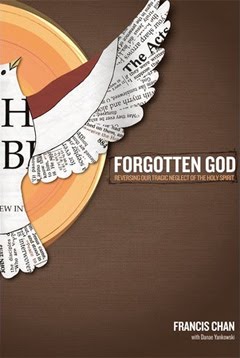
I'm currently reading "Forgotten God: Reversing Our Tragic Neglect of the Holy Spirit," by Francis Chan. I'll readily admit that I was first attracted to the book because of its beautiful cover, but once I discovered what the book was about I was equally excited for its content.
I appreciate Chan's honest writing and Biblical approach to this book. Chan, the pastor of a Cornerstone Church in Simi Valley, California, writes like he's giving a sermon. He presents his points clearly (and with a lot of Biblical references), often urging the reader to put down the book and instead read a relevant section of the Bible.
Overall, the book is a fairly simple and straightforward study of the Holy Spirit. Chan doesn't present anything earth-shattering or new, but instead explores foundational themes central to our belief in the Holy Spirit -- like a list of truths about the Holy Spirit, or a list of ways the Holy Spirit manifests itself in our daily lives.
I'm about halfway through the book, and came to a passage that I found particularly challenging to me personally. The quote I mainly wanted to include here is in bold, but I felt I needed to include the rest for context:
Did God lead you to where you are? A lot of people in my church and in my travels tell me, "I believe that God has called me to Simi Valley." Or Wichita. Or New York. Or Greenville. Or wherever. That very well may be the case. But it could also be a cop-out because you like where you live. You have a good job. The school district is safe and has high ratings. Your family lives close by (or perhaps far away, depending on your relationship with them). It makes sense that you are "called" to be there, right?
And maybe you are calle to where you live. But if you say you are called to be in the place you are, a few questions need to be considered. For example, how would you be missed if you left this place? What would change? Basically, what difference does your presence here make? Or, as my youth pastor once asked me, what would your church (and the worldwide church) look like if everyone was as committed as you are? If everyone gave and served and prayed exactly like you, would the church be healthy and empowered? Or would it be weak and listless?
Yikes. That's an awfully convicting question. If I answered it honestly I'd have to say that the church wouldn't be very healthy at all. Definitely some food for thought.
Subscribe to:
Posts (Atom)