I've been thinking about blogging more lately, and Sarah reminded me of this post I wrote a couple years ago that's seasonally relevant. I thought I'd kick off some blogging by reposting this entry!
***
"There is a stage in a child's life at which it cannot separate the religious from the merely festal character of Christmas or Easter. I have been told of a very small and very devout boy who was heard murmuring to himself on Easter morning a poem of his own composition which began 'Chocolate eggs and Jesus risen.' This seems to me, for his age, both admirable poetry and admirable piety. But of course the time will soon come when such a child can no longer effortlessly and spontaneously enjoy that unity. He will become able to distinguish the spiritual from the ritual and festal aspect of Easter; chocolate eggs will no longer seem sacramental. And once he has distinguished he must put one or the other first. If he puts the spiritual first he can still taste something of Easter in the chocolate eggs; if he puts the eggs first they will soon be no more than any other sweetmeat. They will have taken on an independent, and therefore a soon withering, life." – C.S. Lewis
Ah, more wisdom from Clive. The type of sentimentality and expectancy Lewis describes is probably more often associated with Christmas in this modern day and age, though the lesson is just as potent for Easter.
Children don't think in abstract terms, so to the boy, the thing (chocolate) and the sign (Easter) appear to be one and the same. But the thing is ephemeral, and is consumed – while the sign survives the thing in which it was once incarnate. The boy, then, remembers Easter even when the egg is gone, and is thus faced with the choice that Lewis presents.
How then, does the boy "get back" to the time when the chocolate was both delicious and significant? Does he focus on eating more chocolate, in the hopes that the feeling will somehow return? Or does he look elsewhere for the spiritual nature that made the egg significant in the first place?
What we often mistake as a desire to "consume more eggs" is really a desire to find the divine that makes the eggs significant in the first place. One commentary on this passage uses Communion – eating the bread and drinking the wine – as a metaphor.
"If [a] person puts the spiritual first and desires to have the benefits of the death of Christ sealed to his life, he can still use the sacrament to experience this. If [he] puts the sacrament, the physical ritual of eating and drinking, first in his life, he may become a very religious person, but he will have missed the higher reality to which the sacrament is pointing." - Will Vaus, Mere Theology
I'm fully aware that this post is a bit "out there" and highly theoretical – but the main point is that we seek an understanding of the spiritual that makes our rituals significant, as opposed to engaging in rituals because we recognize that they once held some sacred meaning. Chasing the "thing," as Lewis describes, will make the eggs no longer feel sacramental.
So this Easter, I hope you have many chocolate eggs to enjoy – and I hope that they are full of the meaning and significance of Christ's death and resurrection.

Saturday, April 23, 2011

Tuesday, December 21, 2010
Moving forward by standing still
"There are many ways of going forward, but only one way of standing still."
- FDR
I've been doing a lot of critical thinking about commercials lately. It's funny how ridiculous they become if you stop to think about the premise they're presenting – whether it's gifting unexpected Lexuxes (Lexi?) to a family member, eight-year-olds demanding their parents buy a "cool" car, or relying on the Internet to fix all your problems.
I've paid special attention to two new ad campaigns from Microsoft: one advertising the ways the internet "cloud" improves our lives, families, pictures, and experiences, the other preaching the need for a "phone to save us from our phones."
Here's a commercial from the latter campaign.
The premise, which is unfortunately quite close to the truth: we live in a world where people are so attached to their technology that they seldom look up to interact with their environment. We're so distracted by our music, texts, news, or tweets that we wreck our bicycles, run into things, spill our coffee, and generally miss out on our surroundings.
And here's the ridiculous peddle from Microsoft: what you need to make it better is another, newer, faster phone. You'll free yourself from technology by purchasing more technology.
When you stop to think about it, it's absurd, isn't it? Of course buying a new phone isn't going to help you get off your phone. But we're so busy trying to move forward that we buy it -- we buy the premise, and we buy the phone. And maybe at first it does help, but in the longrun, it just leads to being even more attached to our phones. After all, we just need to keep moving forward, right?
It's a common way to deal with our problems, especially in America, and especially today. There's an idea that progress and technology will save us from ourselves -- that we just need to keep moving forward. Gas getting too expensive? Or running out? That's okay, by the time that happens, we'll have some other technology to fix things.
Now, there's nothing wrong with technology, smartphones, or progress, in and of themselves. I'm simply suggesting that sometimes we need to stand still to really assess where we are and where we're going -- and if we do, we might discover that sometimes the best way to go forward is by going back.
So here's the challenge: stand still. Think critically. Discover the premise behind what you're being sold. Get off your phone and enjoy your surroundings -- not by buying another, newer phone, but by simply taking time to appreciate what's around you. Take out your headphones. Talk to a stranger.
On another note, I think I'm going to try to do a brief series on commercials and the truths they're trying to present. I hope to blog about this again soon.
"If we are to go forward, we must go back and rediscover those precious values - that all reality hinges on moral foundations and that all reality has spiritual control."
- Martin Luther King, Jr.
Saturday, November 20, 2010
Running
Now that I'm getting settled in a new place and establishing a bit of a weekly routine, I've started to get into the groove with running again. I took Gabe with me for the first time today and he did pretty well (he just needs to learn not to make any sharp turns across me when we're running!).
Here's the running playlist for November:
1. Muse - Starlight
I am a huge fan of just about everything Muse does.
2. The Go! Team - The Power is On
I don't know much about this group, but I love this song.
3. Bob Dylan - Forever Young
An updated version of the song that was originally heard on Pepsi commercials during the Super Bowl a couple years ago.
4. Bob Marley - Three Birds
Every little thing... is gonna be alright.
5. Daft Punk - Da Funk
Awesome, driving instrumentals.
6. Muse - Uprising
Another Muse hit about 1984's Winston and Julia. Makes me feel like I'm running from the thought police.
7. Ke$ha - Tik Tok
Okay, okay... guilty pleasure. But it's a really funny song and the beat is great.
8. matchbox twenty - Bright Lights
Baby, baby, baby....
9. Phoenix - 1901 (live)
When this song kicks in I always start to run a little faster.
10. MGMT - Electric Feel (Justice Remix)
The original version of this song was on my playlist for the last half marathon I ran -- but this remix is so much better.
11. The All-American Rejects - Move Along
Probably my second favorite running song, behind Queen's "Don't Stop Me Now."
Thursday, September 02, 2010
"Restoring Honor"
Two interesting reads regarding last week's "Restoring Honor" rally in Washington, D.C.
First, Brian Bantum, a theology professor, writes Is America's Honor a Christian's Honor? Thoughts on Glenn Beck and the "Restoring Honor" Rally (discovered through Eugene Cho's blog). A quick excerpt:
 Bantum's overall point: What "honor" can we really restore? It makes me think of the billboards and bumper stickers I've seen lately that say "America, Bless God." It's not to say that we can't work, as a nation, to live more Biblically, but I'm curious as to other people's thoughts if we can "bless God?"
First, Brian Bantum, a theology professor, writes Is America's Honor a Christian's Honor? Thoughts on Glenn Beck and the "Restoring Honor" Rally (discovered through Eugene Cho's blog). A quick excerpt:
While conservatives such as Beck and Palin point to a time past when America had honor, I am puzzled. Presumably, Beck and Palin mean America had honor in the eyes of God. Presumably, this honor was due to our limited government and desire for individual liberty.
But if we assume this to be true, was God also honored with the systematic displacement of native peoples; the enslavement, lynching, and raping of African women, children and men forcibly brought to our “blessed” shores; and the continual repression of women’s votes just to name a few? Was God being honored when those atrocities were not only permitted, but nationally sanctioned? Is God not honored because millions more have healthcare? Is God not honored because I do not keep what I rightfully earned?

Secondly, Jim Wallis, author of "God's Politics," wrote a piece about the rally on his blog titled "An Open Letter to Glenn Beck." In his post, Wallis particularly challenges Beck's notion that "social justice" churches are bad, and are simply code for a form of Communism or Marxism.
And let’s talk about salvation. You have emphasized that you believe strongly in personal salvation, as opposed to “collective salvation.” As an evangelical Christian, I also believe deeply in personal salvation—it is the foundation of my faith. But we need to ask ourselves, what are we saved for? Is salvation just about getting a pass into heaven? Is it just for us? Or is it also for the world, and being a part of God’s work and purposes in the world today? When I read a passage like Matthew 25 or Amos 5, I believe it’s clear that God won’t hear my prayers if I don’t care for the least of these, or I refuse justice to those in need.
Wallis also warns of the danger of acting as a spiritual leader, and not just as a talk show host (which reminded me of James 3:1 - "Not many of you should become teachers, my brothers, for you know that we who teach will be judged with greater strictness").
Before, I thought you were just another cable news talk show host. But now, you are using the language of a spiritual and even a religious leader. You acted as though you now want people to look to you for that kind of spiritual leadership. But to invoke the name of God and the vocation of a spiritual leader has consequences. It brings with it a whole new level of responsibility and accountability. It will require a more civil and even humble tone than you are used to. It will likely mean saying some different things and, certainly, saying many things differently than you have in the past. Pundits and talk show hosts say things that divide, create conflict, and get good ratings. They appeal more to fear than to hope.
Interesting stuff from these two bloggers. I'm not sure that I have my opinions on "Restoring Honor" and the Tea Party fully formed just yet, but I'm working on it. I'm curious for other people's thoughts as well.
Tough questions
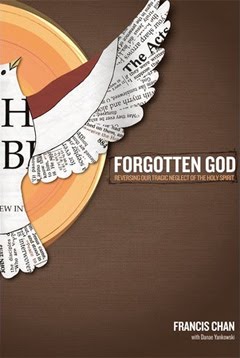
I'm currently reading "Forgotten God: Reversing Our Tragic Neglect of the Holy Spirit," by Francis Chan. I'll readily admit that I was first attracted to the book because of its beautiful cover, but once I discovered what the book was about I was equally excited for its content.
I appreciate Chan's honest writing and Biblical approach to this book. Chan, the pastor of a Cornerstone Church in Simi Valley, California, writes like he's giving a sermon. He presents his points clearly (and with a lot of Biblical references), often urging the reader to put down the book and instead read a relevant section of the Bible.
Overall, the book is a fairly simple and straightforward study of the Holy Spirit. Chan doesn't present anything earth-shattering or new, but instead explores foundational themes central to our belief in the Holy Spirit -- like a list of truths about the Holy Spirit, or a list of ways the Holy Spirit manifests itself in our daily lives.
I'm about halfway through the book, and came to a passage that I found particularly challenging to me personally. The quote I mainly wanted to include here is in bold, but I felt I needed to include the rest for context:
Did God lead you to where you are? A lot of people in my church and in my travels tell me, "I believe that God has called me to Simi Valley." Or Wichita. Or New York. Or Greenville. Or wherever. That very well may be the case. But it could also be a cop-out because you like where you live. You have a good job. The school district is safe and has high ratings. Your family lives close by (or perhaps far away, depending on your relationship with them). It makes sense that you are "called" to be there, right?
And maybe you are calle to where you live. But if you say you are called to be in the place you are, a few questions need to be considered. For example, how would you be missed if you left this place? What would change? Basically, what difference does your presence here make? Or, as my youth pastor once asked me, what would your church (and the worldwide church) look like if everyone was as committed as you are? If everyone gave and served and prayed exactly like you, would the church be healthy and empowered? Or would it be weak and listless?
Yikes. That's an awfully convicting question. If I answered it honestly I'd have to say that the church wouldn't be very healthy at all. Definitely some food for thought.
Personal blogging
Hello, people who might be reading this blog...
If you've followed my blog or photos over the last year, you know I've done a lot of blog switching and designing. A few months after I created the website for my photography earlier this year, I decided that I should probably keep my "professional" blogging (photo portfolio stuff) and "personal" blogging separate. I removed all the personal posts from my photo site and copied them to this blog, which has been dormant since I made the new site. It still has all my old posts from pre-2010 as well.
Anyway, I'll be blogging personally here again now – life updates, theological and spiritual thoughts and questions, silly videos – the whole gamut. Thanks for reading. :)
Sunday, January 24, 2010
To the Lassies
Doug asked me to give a traditional toast "to the lassies" for Burns Night. Below is the poem I wrote and delivered for the toast...
***
"To the Lassies"
The lassies with us here tonight,
Are graced with many gifts,
We count ourselves as lucky friends
Although they give us fits.
For sure, they’re wise and beautiful,
Fair-skinned, with eyes that glisten,
But when they open mouths to speak
We resign ourselves to listen.
And on you go, ‘bout many things:
‘Bout Glee and Harry Potters,
‘Bout knitting, running, vampire men,
And even circus otters.
But that’s not all, as we well know,
For more we often hear,
Of Percy Jackson, word twist games
And even schnabeltiers.
You study eyes, you study books,
And other information;
You work to keep things nice and cold,
and work with animation.
You wrangle germs and viruses
With great dexterity;
And one of you does something strange:
‘sustainability.’
And though we tease, we clearly know,
Your worth to us as sisters;
Without you we would merely be
Sad and lonely misters.
And so, to end this silly rhyme,
I do what just seems right –
I borrow from Sir Burns himself
To celebrate this night:
"Auld Nature swears the lovely dears
Her noblest work she classes;
Her ‘prentice han’ she tried on man,
And then She made the lasses!"
Dear Beth, Christina, Chelsea, Jane,
To you, we raise our glasses.
And Megan, Sarah, Erica –
We toast you, all fair lasses.
Thursday, December 24, 2009
The Law of Undulation
On the drive to Cincinnati yesterday, I listened to a radio dramatization of "The Screwtape Letters," C.S. Lewis' famous look into the mentoring relationship between two devils – a junior tempter (Wormwood), and his uncle, a senior tempter (Screwtape). In the story, Wormwood is tempting his first human, and his uncle gives him tips and hints about how to adequately keep humans away from the "great enemy:" God.
I made it through about half of the set yesterday, and was pleasantly surprised at the quality of the dramatization. I was totally engrossed. The voice acting helped, too – Andy Serkis (Gollum) was fantastic as Screwtape, and the other actors, though lesser known, performed their parts equally well.
I was struck yesterday by the dramatization of the eighth letter from Screwtape to Wormwood, dealing with the "law of undulation." I'd quote the whole chapter if I could, but that wouldn't be exactly legal – so, just a snippet. (Someone has posted the whole chapter, and most of the book, here).
This pattern of undulation won't end until we're at home in heaven. There's a verse in Isaiah that speaks to this:
I made it through about half of the set yesterday, and was pleasantly surprised at the quality of the dramatization. I was totally engrossed. The voice acting helped, too – Andy Serkis (Gollum) was fantastic as Screwtape, and the other actors, though lesser known, performed their parts equally well.
I was struck yesterday by the dramatization of the eighth letter from Screwtape to Wormwood, dealing with the "law of undulation." I'd quote the whole chapter if I could, but that wouldn't be exactly legal – so, just a snippet. (Someone has posted the whole chapter, and most of the book, here).
Humans are amphibians—half spirit and half animal. (The Enemy's determination to produce such a revolting hybrid was one of the things that determined Our Father to withdraw his support from Him.) As spirits they belong to the eternal world, but as animals they inhabit time. This means that while their spirit can be directed to an eternal object, their bodies, passions, and imaginations are in continual change, for to be in time means to change. Their nearest approach to constancy, therefore, is undulation—the repeated return to a level from which they repeatedly fall back, a series of troughs and peaks. If you had watched your patient carefully you would have seen this undulation in every department of his life—his interest in his work, his affection for his friends, his physical appetites, all go up and down. As long as he lives on earth periods of emotional and bodily richness and liveliness will alternate with periods of numbness and poverty. The dryness and dullness through which your patient is now going are not, as you fondly suppose, your workmanship; they are merely a natural phenomenon which will do us no good unless you make a good use of it.Lewis goes on to discuss the role of free will in the "war" for human souls, but that's a slightly different topic (and, of course, a very debatable one). The "Law of Undulation" is, in itself, a broad topic that we can apply to our lives and walks of faith in a variety of different ways. With this blog post, I mostly just wanted to point out how much I believe in the point that Lewis is making – that our lives naturally have highs and lows, because of the way we have been created and because of the sinful and broken nature of our world. Often, when we're in a valley, we look only for the path that will take us to the next peak – but we should recognize that God is in the valleys as much as or more than he is in the peaks. When we find ourselves in a downward trough of undulation, we should ask ourselves what God wants to make of it.
To decide what the best use of it is, you must ask what use the Enemy wants to make of it, and then do the opposite. Now it may surprise you to learn that in His efforts to get permanent possession of a soul, He relies on the troughs even more than on the peaks; some of His special favourites have gone through longer and deeper troughs than anyone else. The reason is this. To us a human is primarily good; our aim is the absorption of its will into ours, the increase of our own area of selfhood at its expense. But the obedience which the Enemy demands of men is quite a different thing. One must face the fact that all the talk about His love for men, and His service being perfect freedom, is not (as one would gladly believe) mere propaganda, but an appalling truth.
This pattern of undulation won't end until we're at home in heaven. There's a verse in Isaiah that speaks to this:
Every valley shall be lifted up,
and every mountain and hill be made low;
the uneven ground shall become level,
and the rough places a plain.
And the glory of the Lord shall be revealed,
and all flesh shall see it together,
for the mouth of the Lord has spoken.”
- Isaiah 40:4-5
Friday, December 18, 2009
Time away

I'm also going to make a point to photoblog during break – especially during the New England trip. Without schoolwork to do, I'll need something to focus on!
Anyway, as I mentioned before, I decided to start off my Christmas break by taking a personal retreat. After spending some time looking for a location, I settled on St. Meinrad, a Benedictine Monastery and seminary in southern Indiana. The seminary had some interesting history – it was founded in 1852 by Swiss monks who were looking to expand their abbey to the United States as an insurance policy against the anti-Catholic Swiss government of the time. If the Swiss government became too oppressive, the monks planned to pack up and move to America. However, that never happened, and by the 1870s St. Meinrad had become an independent monastery.
I arrived Wednesday afternoon and pretty much spent all of my time in reading and prayer. I took an hour in the afternoon to walk around the grounds and take photos, and also attended the evening Vespers service in the monastery. The most interesting reading I was doing was from Tim Keller's "Counterfeit Gods," an excellent book about modern idolatry. When I'm finished with it I may have to devote a post to it.
Anyway, here's a few pictures. These were all taken with my Tokina 11-16mm f/2.8. I'm digging the superwide.


Wednesday, October 07, 2009
When pigs fly.
Well, I'm in for it now.
I've signed up for the Flying Pig Marathon in Cincinnati on May 2. It's 206 days away -- and there's a lot of running to be done between now and then.
To date, I've run four half marathons (soon to be five) with mixed success. I've finished them fine and generally felt good, though I've not really improved my time. I decided that it's time to put some dedicated effort into it and finish at least one full marathon.
Cincinnati is a great choice, too. It's not the flattest course (see the elevation profile below), but I'm from Cincinnati, it's a great marathon, and I should be able to have family and friends there to cheer me on.

And let's be honest -- the Flying Pig marathon? The moniker is perfect. I'm reminded of the "Pigasus," a personal stamp used by John Steinbeck with the latin motto Ad astra per alia porci (to the stars on the wings of a pig). The pigasus was supposed to symbolize Steinbeck's "earthbound but aspiring" nature, as he was a "lumbering soul but trying to fly...(with)...not enough wingspread but plenty of attention." Sounds a lot like my running. I'm currently researching training, but hope to come up with a plan soon!

Sunday, October 04, 2009
Wedding photography!
Yesterday I had my first experience as a wedding photographer – I'll be honest, it was a little stressful – but it was also a lot of fun. Especially since I got to shoot photos of and for such good friends.
By far and large I'm saving the photos so that Jeremy and Erica can see them first (especially the ones of them), but I did want to share a few highlights for those of you that were there. Maybe once I've given them all over to J&E and they're back from their honeymoon I'll post more.
((p.s. -- the pics really aren't looking their best through Blogger. Enjoy anyway!))


Saturday, September 26, 2009
Your favorite president
Quick. Who's your favorite U.S. President?
I'll give you a second. Think of your answer.
Got it?
Did you say Lincoln? Most do.
I recently watched a video where a guy was interviewing students at UC-Berkeley and asking them this exact question – and some of the answers were shocking. Most people said Lincoln – that seems to be the default answer, and for good reason. Lincoln was an immense figure in U.S. history.
However, lots of the other answers were just, well, shocking – many couldn't name one, or when they were asked for reasons for their selection they couldn't come up with any. Anyway, the question spurred my mind into action, and I thought I'd give a quick top three – for argument's sake, I'll exclude Lincoln from consideration (interestingly, my three come roughly from the same era of American history).
 Grover Cleveland (1885-1889, 1893-1897)
The only President elected to nonconsecutive terms, Cleveland was a tireless reformer. While some of Cleveland's policies as a President were controversial (including his support of the gold standard and his intervention in the Pullman strike), he was widely respected for his character. One biographer wrote, "in Grover Cleveland the greatness lies in typical rather than unusual qualities. He had no endowments that thousands of men do not have. He possessed honesty, courage, firmness, independence, and common sense. But he possessed them to a degree other men do not."
After election to his first term, Cleveland ignored the typical spoils system for appointments and instead vowed to presidentially appoint only those who would do their jobs well. Cleveland also undertook efforts to modernize the Navy and created the Interstate Commerce Commission. Cleveland was a Democrat, but was also a staunch believer in limited government, and used the veto more times than any president before. Interestingly, Cleveland is the only president to be married in the White House.
 Teddy Roosevelt (1901-1909)
America's youngest president. America's cowboy president. A man of impeccable character, energy and and achievements, T.R. was the man who coined the term "speak softly and carry a big stick." Roosevelt became president in 1901 when McKinley was assassinated. A Republican president, T.R. was just as well known for his exploits as a naturalist, explorer, soldier and author as he was as a politician. Roosevelt pushed for the completion of the Panama Canal and negotiated the end to the Russo-Japanese War, which earned him a Nobel Peace Prize.
Roosevelt declined to run for reelection in 1908 (remember, there were no term limits then) but ran again in 1912 as a third party candidate, coming in second to the next president on this list. As Roosevelt was campaigning in 1912, an attempt was made on his life. A bullet passed through his metal eyeglasses case and lodged in his ribcage. Roosevelt, drawing on his experience as a soldier, reasoned that since he wasn't coughing up blood he wasn't in any immediate danger. He went on to give a 90-minute campaign speech while the bullet wound bled.
 Woodrow Wilson (1913-1921)
America's only President to ever hold a Ph.D., Wilson was one of America's most idealistic presidents. In Wilson's first term, he worked with the Democratic Congress to pass the Federal Reserve Act, Federal Trade Commission, the Clayton Antitrust Act and the Federal Farm Loan Act and America's first-ever federal progressive income tax in the Revenue Act of 1913. That's a lot for one term, and during Wilson's second term he guided the U.S.'s inevitable entry into World War I.
Towards the end of World War I, Wilson took personal control of negotiations with Germany and issued his Fourteen Points, which enumerated his ideas for a peaceful post-war world. He worked hard to establish the League of Nations, a project that earned him the Nobel Peace Prize. Sadly, Wilson would never see the U.S. enter the league he helped create, in part because Wilson refused to budge from his idealistic positions. During a debate with the Senate in 1919, Wilson collapsed and suffered a stroke. His refusal to compromise meant the U.S. would never ratify the legislation that would enter them into the league.
I'll give you a second. Think of your answer.
Got it?
Did you say Lincoln? Most do.
I recently watched a video where a guy was interviewing students at UC-Berkeley and asking them this exact question – and some of the answers were shocking. Most people said Lincoln – that seems to be the default answer, and for good reason. Lincoln was an immense figure in U.S. history.
However, lots of the other answers were just, well, shocking – many couldn't name one, or when they were asked for reasons for their selection they couldn't come up with any. Anyway, the question spurred my mind into action, and I thought I'd give a quick top three – for argument's sake, I'll exclude Lincoln from consideration (interestingly, my three come roughly from the same era of American history).
 Grover Cleveland (1885-1889, 1893-1897)
The only President elected to nonconsecutive terms, Cleveland was a tireless reformer. While some of Cleveland's policies as a President were controversial (including his support of the gold standard and his intervention in the Pullman strike), he was widely respected for his character. One biographer wrote, "in Grover Cleveland the greatness lies in typical rather than unusual qualities. He had no endowments that thousands of men do not have. He possessed honesty, courage, firmness, independence, and common sense. But he possessed them to a degree other men do not."
After election to his first term, Cleveland ignored the typical spoils system for appointments and instead vowed to presidentially appoint only those who would do their jobs well. Cleveland also undertook efforts to modernize the Navy and created the Interstate Commerce Commission. Cleveland was a Democrat, but was also a staunch believer in limited government, and used the veto more times than any president before. Interestingly, Cleveland is the only president to be married in the White House.
 Teddy Roosevelt (1901-1909)
America's youngest president. America's cowboy president. A man of impeccable character, energy and and achievements, T.R. was the man who coined the term "speak softly and carry a big stick." Roosevelt became president in 1901 when McKinley was assassinated. A Republican president, T.R. was just as well known for his exploits as a naturalist, explorer, soldier and author as he was as a politician. Roosevelt pushed for the completion of the Panama Canal and negotiated the end to the Russo-Japanese War, which earned him a Nobel Peace Prize.
Roosevelt declined to run for reelection in 1908 (remember, there were no term limits then) but ran again in 1912 as a third party candidate, coming in second to the next president on this list. As Roosevelt was campaigning in 1912, an attempt was made on his life. A bullet passed through his metal eyeglasses case and lodged in his ribcage. Roosevelt, drawing on his experience as a soldier, reasoned that since he wasn't coughing up blood he wasn't in any immediate danger. He went on to give a 90-minute campaign speech while the bullet wound bled.
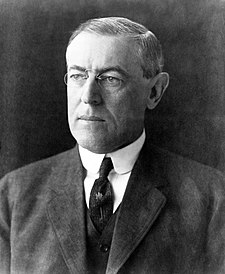 Woodrow Wilson (1913-1921)
America's only President to ever hold a Ph.D., Wilson was one of America's most idealistic presidents. In Wilson's first term, he worked with the Democratic Congress to pass the Federal Reserve Act, Federal Trade Commission, the Clayton Antitrust Act and the Federal Farm Loan Act and America's first-ever federal progressive income tax in the Revenue Act of 1913. That's a lot for one term, and during Wilson's second term he guided the U.S.'s inevitable entry into World War I.
Towards the end of World War I, Wilson took personal control of negotiations with Germany and issued his Fourteen Points, which enumerated his ideas for a peaceful post-war world. He worked hard to establish the League of Nations, a project that earned him the Nobel Peace Prize. Sadly, Wilson would never see the U.S. enter the league he helped create, in part because Wilson refused to budge from his idealistic positions. During a debate with the Senate in 1919, Wilson collapsed and suffered a stroke. His refusal to compromise meant the U.S. would never ratify the legislation that would enter them into the league.
Wednesday, September 23, 2009
Lake Monroe
Last weekend, I was able to head out to Lake Monroe (Indiana's largest lake) to help teach a Coastal Kayaking Class. We went to the easternmost part of the lake, near Crooked Creek, where few motorboats venture and where the lake, apart from a few channels, is less a lake and more a large, swampy marsh, full of eagles, herons, ducks, geese, fish, snakes and sucking mud.
It was a beautiful weekend, and getting outdoors and on the water was a welcome break from the hustle and bustle of grad school. I'll just share a few photos...



We made pizza on the fire – it was amazing.


This last picture is of the largest caterpillar I've ever seen in my life ("like a pickle," as one person put it -- just much, much hairier. And probably less tasty). I looked it up when I got home -- turns out it's an imperial moth: not overly rare (but large, with about a 5'6" wingspan), but rare to see as a caterpillar.
It was a beautiful weekend, and getting outdoors and on the water was a welcome break from the hustle and bustle of grad school. I'll just share a few photos...


We made pizza on the fire – it was amazing.

After beautiful weather on Saturday, storms and low clouds rolled in early Sunday morning. Though it made us wet, the lake was beautiful -- it felt like we were paddling in Alaska or British Columbia. Indiana has its moments.


This last picture is of the largest caterpillar I've ever seen in my life ("like a pickle," as one person put it -- just much, much hairier. And probably less tasty). I looked it up when I got home -- turns out it's an imperial moth: not overly rare (but large, with about a 5'6" wingspan), but rare to see as a caterpillar.
Saturday, September 12, 2009
Welcome back to Blogger
Well, I'm making a return to Blogger for the home of my blog posts. Luckily, I never deleted my old posts from Blogger, so they're all still here! I'm migrating the posts over from Wordpress and they should all be in place in the next week or so.
I'm switching back to Blogger because I'm making my domain an exclusive site for photography -- I might be selling some in the near future! Anyway, personal blog posts don't really belong there, so I'm going to be using blogger again.
I really haven't blogged much in a while, but I have some stuff I want to write about, so I'm happy to have the forum. And, of course, I'll still put up some photography -- I just got the zoom feature javascript working here so you can click on the image below to expand it.

This shot is from my recent backpacking trip to the Appalachian Trail on the Tennessee/North Carolina border. We were in a ton of fog, which spoiled some of the views but made for other beautiful scenery.
Wednesday, June 10, 2009
Of Lorien, Nature and the Four Loves
I'm continuing my Lord of the Rings reread, and I have to say that this time through (this is probably the sixth or seventh time I've read them) I'm focusing on taking deeper lessons from the story instead of just reading for entertainment. Of course, participating in a LOTR book club on Monday nights with some brilliant friends only helps the cause.
One of the themes we've talked about a bit at the book club is nature. Both Tolkien and C.S. Lewis use nature as a thematic element in their fantasy stories, and both seem to have similar methods of introducing and using it.
And as it so happens, I've been thinking a lot about the role of nature in my life lately. I just returned from a wonderful vacation where I got to see both the piney splendor of the Pacific Northwest and the rocky lakeshores of the Catskill Mountains. While traveling, I began to read C.S. Lewis's The Four Loves, which includes a great section about nature. So, let me start this off with a section of The Fellowship of the Ring. The Fellowship has just emerged from the Mines of Moria and, under the leadership of Aragorn, decides to seek refuge in Lothlórien. Boromir shows some reluctance to enter the forest.
He stepped forward; but Boromir stood irresolute and did not follow. 'Is there no other way?' he said.
'What other fairer way would you desire?' said Aragorn.
'A plain road, though it led through a hedge of swords,' said Boromir. 'By strange paths has this company been led, and so far to evil fortune. Against my will we passed under the shades of Moria, to our loss. And now we must enter the Golden Wood, you say. But of that perilous land we have heard in Gondor, and it is said that few come out who once go in; and of that few none have escaped unscathed.'
'Say not unscathed, but if you say unchanged, then maybe you will speak the truth,' said Aragorn. 'But lore wanes in Gondor, Boromir, if in the city of those who once were wise they now speak evil of Lothlórien. Believe what you will, there is no other way for us – unless you would go back to Moria-gate, or scale the pathless mountains, or swim the Great River all alone.'
'Then lead on!' said Boromir. 'But it is perilous.'
'Perilous indeed,' said Aragorn, 'fair and perilous; but only evil need fear it, or those who bring some evil with them. Follow me!'
Boromir isn't afraid to speak his mind, and speak it plainly – even if he is wrong (one of the reasons I like him, but that's another story). Boromir, subject to what must have been the Gondorian equivalent of an urban legend, believes the woods to be wicked and evil. Aragorn corrects him, noting that the woods is dangerous, but that the real danger lies within one's own heart (think Star Wars: Luke's strange cave training with Yoda).
C.S. Lewis echoes this sentiment in The Four Loves.
"If you take nature as a teacher she will teach you exactly the lessons you had already decided to learn; this is only another way of saying that nature does not teach."
Lewis suggests that Nature is a myriad of different things all at once: it's life and death. It's beautiful and terrible. It's forgiving and unforgiving. As Lewis puts it, it at once includes, "overwhelming gaiety, insupportable grandeur and sombre desolation."
But Lewis certainly doesn't suggest that Nature is without its merits. He continues:
"Nature never taught me that there exists a God of glory and of infinite majesty. I had to learn that in other ways. But nature gave the word glory a meaning for me. I still do not know where else I could have found one."
For Lewis, the lesson that Nature taught was one of God's glory. Lewis believes he never would have fully understood God's glory – or learned to fear God – without "certain ominous ravines" and "unapproachable crags." But to others, Nature appeals to the "dark gods in the blood." Though Nature can suggest glory, it presents other things, too – sex, hunger and power operate in Nature without shame.
We can certainly see this idea of nature as a "mirror" in Tolkien's Lothlórien, among other places. Boromir is right to fear the woods, because the woods will expose the fears that he carries in his heart. Tolkien's Nature, in and of itself, is not good or evil. It may reflect the good or evil present in it (as I'll note presently) or, in its natural course cause actions that seem to be good or evil, though they are neither (the foiling of the Fellowship on Caradhras).
We can see the effect of good or evil in nature if we read on to the end of the Lothlórien chapter. The Fellowship has reached Cerin Amroth, a hill with a vantage point of the surrounding lands. Frodo pauses to look out over the golden wood:
Frodo looked and saw, still at some distance, a hill of many mighty trees, or a city of green towers: which it was he could not tell. Out of it, it seemed to him that the power and light came that held all the land in sway. He longed suddenly to fly like a bird to rest in the green city. Then he looked eastward and saw all the land of Lorien running down to the pale gleam of Anduin, the Great River. He lifted his eyes across the river and all the light went out, and he was back again in the world he knew. Beyond the river the land appeared flat and empty, formless and vague, until far away it rose again like a wall, dark and drear. The sun that lay on Lothlorien had no power to enlighten the shadow of that distant height.
'There lies the fastness of Southern Mirkwood,' said Haldir. 'It is clad in a forest of dark fir, where the trees strive one against another and their branches rot and wither. In the midst upon a stony height stands Dol Guldur, where long the hidden Enemy had his dewlling. We fear now that it is inhabited again, and with power sevenfold. A black cloud lies often over it of late. In this high place you ay see the two powers that are opposed to one another; and ever they strive now in thought, but whereas the light perceives the very heart of the darkness, its own secret has not been discovered. Not yet' He turned and climbed swiftly down, and they followed him.
Nature can appear to be good or evil depending on both what is inhabiting it, and, again, depending on the perspective of the beholder. As Lewis would say, it teaches us no lessons than those we already wish to learn.
Instead, Lewis suggests we should "learn our theology and philosophy elsewhere." That we must "leave the hills and woods and go back to our studies, to church, to our Bibles, to our knees." And, in a specific note to nature lovers, Lewis continues, "Otherwise the love of nature is beginning to turn into nature religion. And then, even if it does not lead us to the Dark Gods, it will lead us to a great deal of nonsense."
I don't know about you, but to me this all makes perfect sense. I believe wholeheartedly – especially since I tend to be a "nature lover" – that the love of nature must be anchored in truth. Additionally, Tolkien's storytelling seems to back up the theological stylings of his good friend Lewis. Lothlórien is just one example.
As a parting thought: At book club on Monday we discussed Radagast, Gandalf's wizarding peer with a deep affection for nature (and possible St. Francis parallel). If Lewis suggests that a pure love of nature will, at best, lead to a "great deal of nonsense," then perhaps that's one reason why Radagast is considered a simpleton and a fool in the books.
Sunday, May 24, 2009
Vacation, briefly
I don't have much time to compose a post this morning, but I thought I'd post a couple pictures from the vacation so far. It's amazingly beautiful here. The weather has been great, the travel easy, and we've seen an incredible amount of things in just a few days. We were in Yosemite National Park the last couple days and today are back in San Francisco. We're going to do some things here today (Golden Gate Bridge, etc.). Should be a fun day!
The Mariposa Grove in Yosemite National Forest:
The view from our backcountry campsite in Yosemite:
On a random dome in northern Yosemite:
The Mariposa Grove in Yosemite National Forest:
The view from our backcountry campsite in Yosemite:
On a random dome in northern Yosemite:
Sunday, May 10, 2009
Sunsets + Summer Reading
Ah, summer is finally here. I went camping last night at Yellowwood to kick off the summer properly. Since I changed the blog design the photos show up kind of small, so a reminder that if you click on them they'll expand to full- screen.
More blogging to come now that exams are done!

Wednesday, April 22, 2009
Everything is amazing, no one is happy
A friend sent me a link to this youtube clip of a comedian – Louis CK – on Conan the other night. I've never heard of him, though I appreciate his simple message in this clip.

Friday, April 17, 2009
My backyard
One of the reasons I moved into my current apartment was because I liked the fact that it had a nice, wooded backyard that – complete with a fire pit – that was dark at night.
Well, my landlord really hasn't turned out to be such a great guy. The place isn't so hot either. For the last couple weeks they've been doing some kind of mysterious work to the apartment downstairs (the one that always has bass coming from it, regardless of the hour) – and so this is what the backyard looks like.
This picture was inspired by the fact that the guy that my landlord hires to do stuff decided to mow today, so he just literally mowed over and around all this crap. Classic.

And here's the challenge. Can you all of these things in the photo? If you can, you win!
- Snow shovel
- (4) half-cinder blocks
- One FULL cinder block
- Croquet set
- Taco bell cup
- McDonald's cup
- Coffee mug (with coffee still in it)
- Tire
- Bag of cypress mulch
- Mysterious cable
- Empty bottle of mountain dew.
Sunday, April 12, 2009
l'amour de Dieu est folie!
In France, when Easter is celebrated, there is a common phrase that is proclaimed in cathedrals, shared on sidewalks, spraypainted on walls and plastered on streetlights.

l'amour de Dieu est folie!
The love of God is foolish!
What a great phrase. Why don't we have anything like it here?
Now, we know God is infinitely wise and omnipotent. It's a bit odd to call him foolish, isn't it? It's simply foolish because we can't possibly fathom or understand God's love for us. We are broken, sinful creatures, yet God loves us. Magnificently. Spectacularly. Undeservedly. And I can think of no better time to proclaim the glory of God's foolish love for his creation than on Easter, the day of Christ's resurrection and victory over death.
1 Corinthians says it better than I ever could.
"For the word of the cross is folly to those who are perishing, but to us who are being saved it is the power of God. For it is written,“I will destroy the wisdom of the wise,
and the discernment of the discerning I will thwart.”Where is the one who is wise? Where is the scribe? Where is the debater of this age? Has not God made foolish the wisdom of the world? For since, in the wisdom of God, the world did not know God through wisdom, it pleased God through the folly of what we preach to save those who believe. For Jews demand signs and Greeks seek wisdom, but we preach Christ crucified, a stumbling block to Jews and folly to Gentiles, but to those who are called, both Jews and Greeks, Christ the power of God and the wisdom of God. For the foolishness of God is wiser than men, and the weakness of God is stronger than men.- 1 Corinthians 1:18-25 (ESV)
Happy Easter!
Subscribe to:
Posts (Atom)